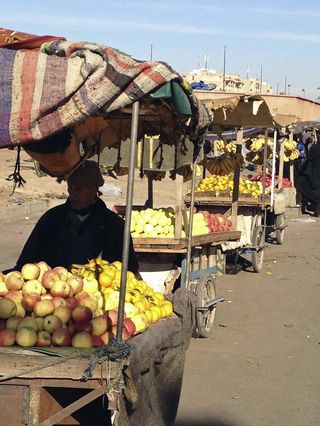

There are many ways to compete in a marketplace. You already know them.
But are you really conscious of your place in the market?
How do your customers define you? How do you define yourself? What makes you special? You’ve got to know what you do better than the other guys and deliver even more of that.
You cannot do everything so letting the other guy offer the cheapest price or have the slickest product is just fine of you’ve, say, got the very best service.
Produce markets in Morocco
This past long weekend I was in Morocco and became fascinated with the local produce markets. I went to several in Marrakech and a country market in Asni at the foothills of the Atlas Mountains that's held once a week.
The produce sellers offer the same basic items and sell in a similar way. But lingering and observing, I noticed ways the proprietors differentiated.
Location - Some sellers got prime position near the entrance to the Medina (ancient walled city) in Marrakech. A similar strategy was to stake out a position near the entrance to the marketplace in Asni. I'm not sure if these spots go to the first to arrive in the morning or if somebody is paid, but there are definitely good and bad locations.
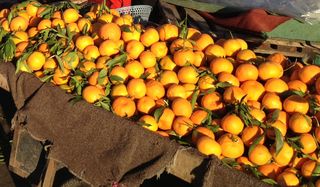
Product – It was orange season in Morocco. The oranges were at nearly every stall and were delicious and cheap. I ate so many I thought my skin would turn orange. If everyone basically sells the same thing, how do you differentiate product? Then I noticed that some sellers had leaves still on the oranges they were selling. This indicated that the fruit had just been picked because the leaves quickly wilt.
Comfort – A few stalls had coverings where people could shop outside of the hot sun. While this might be comfortable to haggle over some fruit and veggies, it was very bright and the direct sun enhanced the look of the products so…
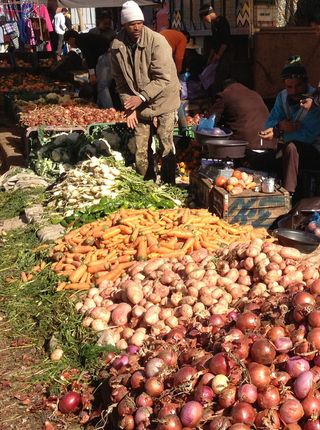
Display – When artfully arranged in direct sunlight, the items just looked tastier.
Service – Being friendly, offering a free sample, tossing in a few extra, packaging in two bags instead of one to make it easy to carry are indications of good customer service, another way to differentiate.
Price – When everyone sells the same thing, there’s a low cost provider. But with margins thin, that’s a tough position to be in.
Advertising – Some of the sellers called out information about their fruit and vegetables.
Sales – Some sellers tried to hustle people into their stalls. But usually the hard sell doesn't work.
Kindness – Some sellers just smiled and caught your eye.
There are probably other ways the produce sellers differentiated that I didn’t notice. Certainly as I don’t speak the local Berber language, there was a lot happening that I didn’t catch.
How do you compete?
We all compete for business in a crowded marketplace of ideas, services, and products. There are many different ways to compete and differentiate your offerings. Copying the other guys is a tough way to succeed.
You've got to know how you're different than the other guys.
You've got to stake a claim as being the best at something.
Photos by David Meerman Scott taken with an iPhone 4S


A great way I've discovered for businesses to stand out in homogeneous industries (e.g. banking, title services, etc.) is to stake claim to a very popular aspect of what you and your competition does.
My favorite example is a beer company that started pitching the mountain-fresh crystal-clear water used to make their product. The whole company image was rebuilt around this claim. They moved into the top 5 in their industry as a result even though every other beer manufacturer used the same high-quality H2O. After this company leveraged the fact, anyone who tried to do the same afterwards looked like a wannabe.
Posted by: JoeBeaulaurier | December 17, 2012 at 06:30 PM
Joe - Great point. I wonder if any of the Moroccan oranges were marketed as "organic" (or perhaps that's how they are all grown).
Posted by: David Meerman Scott | December 18, 2012 at 03:50 AM
Growing up in Morocco and going to the Market with my mother, she always went back to the same sellers. Why? It's very simple, quality and customer service is what kept her coming back.
Posted by: Ben | December 18, 2012 at 08:05 AM
Hey Ben. I'm so glad you commented - I really wanted to hear from someone with direct experience in the markets. "Quality and customer service" is always a great differentiator. Many thanks for taking the time to jump in.
Posted by: David Meerman Scott | December 18, 2012 at 09:24 AM
What an excellent, simple and apt example to show how marketing works on a wider scale in the branding world. Product differentiation is one of the toughest things to achieve and you've demonstrated not only the scale of the problem, but also how it can be overcome!
Posted by: My Bravo 95 | December 18, 2012 at 11:28 AM
Great post David, Having lived and worked all over the middle east and north africa - i loved going to the markets - they are such a great environment to learn about customer service and customer experience.
I agree with Ben, that the one thing that differentiates the hundreds of traders in the markets (from Istanbul to Marakech) is the quality of the products AND quality of the customer service.
But even more than that, what i found that the successful traders (the ones we went back to all the time) did differently was how great the whole customer experience was, and how they managed to build relationships with every customer. You walk away glad for the experience, and feeling like for that instant you were the most important person in the traders universe.
So for me, when price is uniformly low, you differentiate with great customer experience and by building real relaionships with your customers.
Posted by: Yaseen Dadabhay | December 19, 2012 at 07:47 AM
Yaseend - Thanks for your input. I've been to markets in Cairo, Instanbul, and now Morocco so nowhere near the number of places as you and I have the disadvantage of not speaking the local language. However, I'd agree that customer experience is the most important thing.
Posted by: David Meerman Scott | December 19, 2012 at 08:31 AM
Great insights here, David! To Ben's point about growing up in Morocco and his memories of why his mom kept going back to the same vendors, there's something satisfying about building a long-term relationship that can work for both buyer and seller. It's no longer a simple transaction. I had similar experiences with the vendors at the weekly street produce market in our neighborhood when I lived in Brazil.
Posted by: John Balla | December 19, 2012 at 10:52 PM
John, I didn't know you lived in Brazil (or if I did I've forgotten). Yes, I've had similar experiences - for example my local sandwich guy is more expensive than other options near my office but I go back for the service.
Posted by: David Meerman Scott | December 20, 2012 at 05:00 AM
Another great blog David. Sadly, it is still very difficult to convince companies in my sector (biotech, pharma and life science) to undertake even a small amount of market research (and brand auditing where appropriate).
After all, how can you own your niche if:
a) you don't know what it is, or just assume you know what it is and
b) you have no real idea about the true needs of your customers, and how you can meet those needs?
It seems that the cooler the technology, the harder it is to convince companies to actually find out who might need their tech and why... and in my experience, that can be a major recipe for disaster.
I guess if oranges are in season and you know your customers will be interested in the taste and hydration they offer, that's an easier sell. But what about when customer needs are more complex, and you need to differentiate your offering?
Any experience trying to convince CMOs / CEOs of the importance of accurately understanding their market before they start promoting and selling their product?
Posted by: Paul Avery | December 21, 2012 at 06:44 AM
Paul - While oranges may seem "easier" I think because it is such a commodity that makes it more difficult. They high tech stuff like your marker while seemingly more difficult to brand in my opinion offer the much better opportunity because you can have an intense focus on a niche with few competitors and very high barrier to entry.
Posted by: David Meerman Scott | December 21, 2012 at 09:05 AM
I agree with your point David, but having a cool technology is not a customer benefit in its own right. Biotech is also a very disruptive area, as new techniques (and technologies) are being developed all the time - the key is to align a given tech / method with the application it is best designed to serve. Often, this is just guessed without the company pausing to position themselves accurately within the market, with messages optimized to specifically reach and engage with their target subset.
Posted by: Paul Avery | December 21, 2012 at 10:50 AM
You are right of course, Paul. Most marketers never conduct buyer persona research so they default to talking about product features and made up benefits.
Posted by: David Meerman Scott | December 21, 2012 at 04:02 PM
This was a great post supplemented with comments I totally agree. Selling commodities successfully requires you to differentiate, you really need to provide some extra to keep it running. I consider this extra, what ever form it has, all customer experience. In many cases it's a solution to the "hidden" or difficult to realize problem that your customer has.
Posted by: Teijo Taipale | January 05, 2013 at 10:54 AM
When i visit such areas, where i don't know their languages, naturally i get a native or homely feel at the persons, who smile at me rather than the one, who compels me to come in to their shop. On the other hand I'd like mention a fact that Every seller has to be a customer first, but once they become a seller, they try to look into the minds of their competitor first, and that's why they feel tough to see things from the eyes of their customer.
Posted by: Arun | January 30, 2013 at 02:10 PM
Market competition must be kept in mind before entering into any business.A competitive study of t he market rivals will not only reveal their strengths but also help in changing strategies as and when required.A competent company offering solutions needs to be receptive to dynamic market conditions, without the latest updates from market, no company can emerge as a leader-a mantra well understood at Synechron, and most important differentiation in some way is indispensable constraint for long term goal accomplishment.
Posted by: Sheetal Sharma | February 19, 2013 at 01:34 AM