



UPDATE October 30, 2012 at 10:20
Mike Volpe, HubSpot CMO, apologized for the tone of the original post in an update to it now called Is Newsjacking Hurricane Sandy Right or Wrong?
The original HubSpot post sparked a very important discussion which was continued here and in Mike's update. We needed to get these issues out in the open. Getting the pros and cons of newsjacking out there is incredibly valuable.
+++++++++++++++++++++++++
ORIGINAL POST
I love the HubSpot blog. Normally, I agree with what they have to say and I frequently tweet links and leave comments. I am an advisor to the company and wrote Marketing Lessons from the Grateful Dead with HubSpot CEO Brian Halligan, so I have deep ties to the company.
HubSpot got this one wrong: 5 Hurricane Sandy Newsjacks From Marketers.
Having written the book Newsjacking: How to Inject your Ideas into a Breaking News Story and Generate Tons of Media Coverage I feel I need to jump in here and offer my take.
When newsjacking is in poor form and can damage your brand
According to early news reports (I'm writing this early in the morning after the storm hit), Hurricane Sandy has caused $20 billion in economic damage and at least 15 people have lost their lives. A million people have been under orders to evacuate their homes and 7 million people are without power.
This is not the sort of story to promote cosmetics and fashion, two ideas on the HubSpot post.
These sorts of frivolous newsjacking ideas give the concept of newsjacking (and marketers in general) a bad name because it is a blatant attempt to exploit a tragedy.
Newsjacking is a powerful tool, but you risk unleashing the power in a negative manner that can seriously harm your brand if you exploit something in poor taste like a major storm. Kenneth Cole learned this lesson the hard way when he attempted to newsjack the revolution in Egypt.
You need a legitimate tie to the story
To be successful, attempts at newsjacking must have a legitimate tie to the story, especially when the story is about a disaster, death, or any other negative. The examples in the HubSpot blog post about marketers relating fashion and cosmetics to Hurricane Sandy are in the Kenneth Cole category.
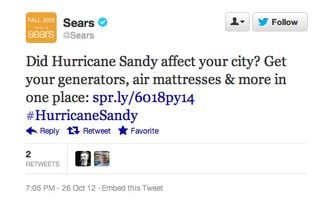
The HubSpot post also references a tweet by Sears pointing to supplies they sell that could be useful in the storm’s aftermath such as generators. This is an example of a legitimate tie and something that is valuable.
Sears would really nail it if they offered a real-time store search feature so consumers could find out if their local store had supplies such as batteries and generators. I could see that being picked up in the media and benefiting Sears.
Newsjacking
I'm thrilled that the ideas in my Newsjacking book have become popular with marketers. As an author, that's the ultimate – having others take your idea and run with it. But newsjacking is tricky. We’ve got to work together to show not only the positive side, but the potential pitfalls as well.


Slips like these tell you that true vulgarians are behind these brands.
Posted by: Bob James | October 30, 2012 at 08:58 AM
I am very grateful for your post and the rationality you are providing the marketing community. Several of my credit card companies sent notices out to affected areas notifying them that late fees will be waived this week, and offered emergency cash assistance to anyone who needs help due to the storm. Their notices were sincere and relevant. The kind of examples I believe you intended with your book.
Posted by: Samantha Stone | October 30, 2012 at 08:58 AM
Samantha - Yes, thank you for offering those. I agree that the credit card company examples are valuable information for consumers when power is out and are therefore a legitimate use of newsjacking.
Posted by: David Meerman Scott | October 30, 2012 at 09:00 AM
Great post, David. Couldn't agree more. HubSpot (whose content I generally enjoy), should have never put that post up. It was in really poor taste and I would imagine someone, somewhere at HubSpot agrees.
I also found the Sears post to be in really poor taste and tweeted at them publicly to indicate so. What would have been much more helpful would have been to offer to donate items to shelters, etc. in heavily affected areas.
Finally, I too received the bank and credit card notices referenced by Samantha and thought they were appropriate and in good taste and it left me feeling even more glad (if one can feel glad about having credit cards) that I was a customer.
Posted by: JamiePappas | October 30, 2012 at 09:07 AM
Frankly, it's surprising that an exceptional company like HubSpot would post such a thing. When it comes to people's lives being threatened by a natural disaster, I don't think there's any excuse for newsjacking unless it aims to help those in need. At least they revised their post somewhat. Still, I expect better from them and hope others won't make similar mistakes in the future.
Posted by: Brett Heitz | October 30, 2012 at 09:09 AM
Brett and Jamie - thanks for jumping in. Yes, in this case, newsjacking is legitimate when it is seen as helping those in need.
Jamie, I think the Sears example is okay in the sense that the products talked about can make people's lives better in the aftermath of the storm. But like I said, it would be much more appropriate had they posted a widget that allowed consumers to see real-time updates on availability of things like generators in each of their stores.
Posted by: David Meerman Scott | October 30, 2012 at 09:14 AM
Hubspot seems to be making a habit of this sort of behavior lately.
Here's one where a Hubspot employee leaves a comment about over-the-pants-hand-jobs with a commenter's underage daughter. In a public feed, during work hours, with the Hubspot brand attached: http://digitalstrategy.typepad.com/digital_strategy/2012/10/why-you-need-a-social-media-policy-even-if-youre-hubspot.html
Volpe chimes in at the comments to note that the employee made a poor judgement call. But you put enough of these things together and we get a narrative about leadership and the kind of people who work there.
If you don't have a policy for avoiding stuff like these two situations that's fine. But then leadership needs to take responsibility for bad hires, bad actors and doing something meaningful when the bad happens. Saying someone made a poor decision doesn't qualify.
Posted by: John Norman | October 30, 2012 at 09:18 AM
Very well said. It can be a thin line to walk, but really it shouldn't be. Marketers are always looking for that next bright idea or hook to capture attention and drive traffic. This is a good reminder that you should always try and bake in time (if only a pause) to push away from the keyboard and ask a tough question or two. I too agree the Sears approach could be better, but isn't really an issue. Great post.
Posted by: Heath Umbach | October 30, 2012 at 09:35 AM
I wonder if this is a case of systematizing something in the minds of young marketers that we cannot systematize.
There are lives, global economies, and people’s livelihoods at stake. But I have seen this before with young, fast paced marketers who are trying to do the right thing by putting their brands everywhere. The problem is that the system requires common sense, application of thought and ethics. I'm not saying that the blogger or Hubspot lacks ethics – I actually don’t believe that to be the case - but I do think that as marketers we need to work just as hard to help our employees do the right thing as we do to encourage them to do the most creative things in the shortest periods of time.
As always David a great dialogue to open up here.
Posted by: Jane Hiscock | October 30, 2012 at 09:38 AM
Heath - With each new marketing technique, the limits get tested. Email marketing leads to spam and then there is a backlash. SEO leads to black hat techniques and then there is a backlash. Newsjacking is a new concept and people are testing the outer boundaries.
Posted by: David Meerman Scott | October 30, 2012 at 09:39 AM
I'm really glad you commented on this, as the author of Newsjacking your words carry a lot of weight.
I saw the Hubspot post last night, and had the same reaction: the Sears example is okay, but the rest seem crass and tone-deaf to the situation at hand.
Posted by: Jen Zingsheim | October 30, 2012 at 09:44 AM
I want to be very clear and apologize for the article. The tone was completely wrong and insensitive. We are deeply concerned about our friends affected by the storm and we even have many employees still without power. The tone of this article was in poor taste.
Obviously we had nothing to do with the other companies mentioned who did the newsjacking, we were reporting on those attempts. However the author of the article passed a value judgement on them and we should not have done that.
The tone of the article should have been "Are these newsjacking attempts right or wrong?" or "Should you newsjack a natural disaster?". I think then having the marketing community discuss the merits of the different newsjacking attempts in the comments is a worthwhile discussion.
I have taken the article down.
Posted by: Mike Volpe - CMO @ HubSpot | October 30, 2012 at 09:45 AM
John Norman - I have read the post you mention. I do not see the two things related. In this post, I wanted to talk about inappropriate newsjacking. The issue you site is one of bad judgement. I don't agree that you can take these two isolated incidents and make a case about something systemic at HubSpot.
Jane Hiscock - I remember back several decades when I was a young marketer. I think there is potential danger with some people and with some companies that it is getting attention at all costs. I was guilty of that once. I am not suggesting that's the case with HubSpot here. I'm just offering my view on their take on newsjacking the storm with the hope, as you say, to help people do the right thing.
Posted by: David Meerman Scott | October 30, 2012 at 09:48 AM
Mike, thank you for jumping in.
While I do agree that the tone of the blog post was off, the post actually sparked a very important debate. This is a discussion that needed to happen.
Posted by: David Meerman Scott | October 30, 2012 at 09:53 AM
I posted this on your Facebook page as well and I hope you'll forgive the duplication. We are trying to use our community resources to help people and share useful information. If you or any of your readers have suggestions for how we can help, please tweet them to @MarketingCloud.
I hope no one thinks I am being opportunistic posting this here. This is part of a sincere effort to ask as many people as possible what we can do besides just compiling mentions of the hurricane. Currently we are re-tweeting shelter information and information from emergency services, but I want us to do more if we can.
David B. Thomas
Salesforce Marketing Cloud
Posted by: DavidBThomas | October 30, 2012 at 10:13 AM
Updates:
1) Rather than removing the original post, I have changed it so (a) it contains an apology and (b) we the marketing community can discuss the right and wrong of newsjacking in the comments.
2) HubSpot is making a $5,000 donation to the Red Cross to support those affected by Sandy.
Posted by: Mike Volpe - CMO @ HubSpot | October 30, 2012 at 10:21 AM
http://mydisruption.wordpress.com/2012/10/29/hurrican-sandy-marketing/
An example of positive newsjacking, IMO (assuming, of course, it's not a scam!).
Best,
Dave
Posted by: MyDisruption | October 30, 2012 at 10:32 AM
With all due respect, David, this post feels like newsjacking a newsjack of a newsjack.
Hubspot made an error in the tone / evaluative slant of their post as they commented on brand newsjacks, but your response here feels less like an opinion piece on a controversial strategy, and more like a book promotion -- there's a cover image and a title link in the first fold.
It is salient, of course, that you wrote a book on the topic as you share your opinion, but writing this post the morning of the day after the hurricane, writing it about a company that you advise, including two links to promote your book and using the cover image as the first image in the post immediately struck me as opportunistic.
I honestly don't mean any disrespect, as I'm sure you don't to Hubspot here (and for the record, that post infuriated me), but you may have erred a little on the wrong side of sensitivity here.
Posted by: Meg | October 30, 2012 at 10:33 AM
Meg, thanks for that input. I debated putting the cover as an image in the post. Now I wish I hadn't.
Posted by: David Meerman Scott | October 30, 2012 at 10:34 AM
David, in regard to your most recent comment in response to Mike, I couldn't agree with you more. Definitely an important topic as we move into the real-time, newsjacking reality of marketing today. (And Mike, thanks for sharing your honest sentiments.)
I saw a Ragan's article yesterday offering tips on how to pitch the media (or most likely, not) during the disaster - http://www.prdaily.com/Main/Articles/13035.aspx. Thankfully, it encouraged PR pros to avoid making pitches during this time. I admit I had some concerns upon clicking through that it may offer tips to distastefully newsjack the storm.
@laurelmackenzie
Posted by: Laurel Miltner | October 30, 2012 at 10:47 AM
Thanks for this post and the attempt to clarify when newsjacking goes too far. If a brand has something useful to add to the discussion that happens to promote one of their products-- so be it. I don't see it as an intrusion for businesses to share that they have power or supplies available when there is clearly a demand for those things.
What is clearly in poor taste are things like this: on my Facebook wall yesterday was a post from a jewelry company advertising an "online storm sale" accompanied by a photo of a hurricane storm cloud with jewelry flying inside of it. Wish I was making it up.
Posted by: Cindymeltz | October 30, 2012 at 11:40 AM
Well said David. And kudos for speaking out despite being on the Hubspot payroll.
Posted by: Mark Bower (@markbower) | October 30, 2012 at 11:43 AM
You're right, news-jacking is a powerful tool, but should be used with care and consideration - not only for the news item itself, but for the product being associated with it. People are more and more aware of brands and branding and attuned to the ways they try to self-promote. So always be candid and honest and upfront - even about your news-jacking!
Posted by: Framed prints | October 30, 2012 at 12:43 PM
David,
It had to be said and you said it. Piggyback Publicity, as I often refer to it, can be very powerful in spreading your message. The question is, What message are you sending? When the message you're sending is that you're an insensitive baboon, you may want to reconsider.
Great stuff as always David.
Tsufit
Author, Step Into The Spotlight!
Posted by: Tsufit | October 30, 2012 at 01:24 PM
David - I think the safe rule for newsjacking is: Is this issue killing anyone or depriving them of the essentials of life?
The Arab Spring was off-limits (Kenneth Cole learned that one)
Hurricanes also (HealthWorks, HubSpot, others) People died, are dying, and are losing their homes and more
Steve Jobs (AppSumo, by accident, sent an email with a subject line referencing SJ the morning after he died)
These countless examples of people who don't know and make these mistakes can go on and on. I think the rule works though. A friend of mine tried to counter with, "What about alcohol, or cancer?"
That's right - You can newsjack alcohol generally, but if a celebrity or someone visible dies from alcohol abuse, it's inappropriate to newsjack that story with your own messaging. The overall topic of cancer is something you can build something on (maybe, I wouldn't do this but I could be convinced there's a way), but don't do it the day someone dies of cancer.
I think this is a safe rule. What do you think?
(Disclaimer: I am a former employee of HubSpot.)
Posted by: Brian Whalley | October 30, 2012 at 01:39 PM
Thanks to all for jumping in on this. The discussion has been excellent.
Posted by: David Meerman Scott | October 30, 2012 at 01:55 PM
Loved your post, David. I totally agree with you and was also very shocked by the many irresponsible social media posts during Sandy!
In light of your term, a co-worker of mine now refers to this unsuitable behavior as "newsjack(ass)ing," in which she further describes in the blog post below. Check it out here:
http://hmgcreative.com/blog/social-media-2/newsjackassing-pr-fail-in-the-wake-of-tragedy-and-crisis-2/
Posted by: Stacey Donelan | October 31, 2012 at 04:27 PM
Thank you Stacey. I just commented on Amy's blog.
Posted by: David Meerman Scott | October 31, 2012 at 05:58 PM
Thanks for posting David. I think actually disasters and emergencies do afford an opportunity for companies to promote themselves in one important way: by offering value and help to those affected. Whether they are donating funds, products or services, running a fundraiser, or providing volunteers, companies can help people and communities, and get credit for doing so by their communities and employees. You could call that newsjacking because they do get coverage, and that is certainly part of why they do it, but it's legit, and perhaps the only truly appropriate way to respond to this type of situation.
I think that's the direction you were going with what Sears could do - how can they provide value for those affected? I'm sure there are many better examples, but two I can think of from my industry include during Katrina when the operators quickly enabled a program where donations could be made for victims via text messages, and now in the wake of Sandy, opertors that have partnered to provide free, seamless roaming to consumers left without enough tower coverage on their cell phones.
Posted by: Jessica Zimet | November 01, 2012 at 11:00 AM
I have been following this discussion for the past few days and have found it fascinating! As someone who is both studying and interning in public relations (but am by no means a professional), I am intrigued with the concept of newsjacking. It seems like a simple concept at first. All you have to do is redirect the momentum of a breaking news story, while providing a unique perspective, towards your company. However, as the examples from HubSpot and Kenneth Cole have shown us, it is much more difficult than it seems.
Based on my limited experience, one of the most challenging things about public relations is the short window available for responding. When something goes wrong (or right in some cases), a quick response is needed, regardless of whether or not all the information is available. It is also the same with newsjacking. In order to benefit from a story's momentum, a response is needed within hours, or days with a crisis like Hurricane Sandy.
This is likely what went wrong with the previous instances. I personally don't believe that these businesses were trying to offend. They probably viewed their posts as being lighthearted and humorous. Unfortunately, in a rush to newsjack Sandy as fast as possible, they seemed to forget to stop and think about how the public would perceive their posts. This is where the balance between posting quickly and posting thoughtfully comes into play. In my opinion, it is better post later but thoughtfully than to respond earlier but questionably. The public will still appreciate the former (even if it is late) but be outraged with the later (even though it was posted earlier).
While newsjacking a very powerful too, it is still new and unfamiliar. After all, it can difficult to predict what posts will work and which won't. However, I do believe that David's guidelines are great rules to follow. A company needs to have relevance to the event taking place and tragedy should never be exploited.
Posted by: Tim Lawler | November 02, 2012 at 12:35 AM
Jessica - A good example is Duracell. They've set up mobile phone charging stations in areas without power. People are praising the effort on their Facebook page. http://www.facebook.com/duracell
Tim - thanks for jumping in. Yes, there is a much shorter window than in the past because of the real-time nature of the social web. I suspect what happened with companies like American Apparel that got called out for being inappropriate is that someone charged with generating attention jumped in to Newsjack while those charged with reputation management didn't know what was happening. It's a learning experience for all of us.
Posted by: David Meerman Scott | November 02, 2012 at 04:57 AM
As a general rule of thumb, it is only okay to newsjack a sad news story like Hurricane Sandy if you are offering assistance of some kind. If you are simply promoting your own product, then be prepared for public backlash.
Even the Sear's tweet is borderline poor taste. They should have at least offered some type of discount to help those that are currently struggling with no electricity to show they genuinely care as opposed to simply wanting to sell products.
Posted by: Martin Kang | November 04, 2012 at 08:55 PM
At last, I received the bank and credit card notices referenced by Samantha and thought they were appropriate and in good taste and it left me feeling even more glad that I was a customer.
Posted by: Trott | November 05, 2012 at 03:01 AM
Unfortunately, in a rush to newsjack Sandy as fast as possible, they seemed to forget to stop and think about how the public would perceive their posts. This is where the balance between posting quickly and posting thoughtfully comes into play. In my opinion, it is better post later but thoughtfully than to respond earlier but questionably.
Posted by: woolrich outlet | November 29, 2012 at 09:47 PM
I’m really enjoying the design and layout of your site. It’s a very easy on the eyes which makes it much more pleasant for me to come here and visit more often. Did you hire out a designer to create your theme? Excellent work!
Posted by: Almost Isn’t Good Enough | December 11, 2012 at 08:57 AM
My design work is done by @Eymer
Posted by: David Meerman Scott | December 11, 2012 at 09:19 AM
Great discussion guys and I am really happy to read this post!
Posted by: Alan Fascia | January 08, 2013 at 11:23 AM