



This is David Byrne week.
There is an important content marketing lesson to be learned from the Talking Heads front man and Rock and Roll Hall of Fame inductee, but first some background.
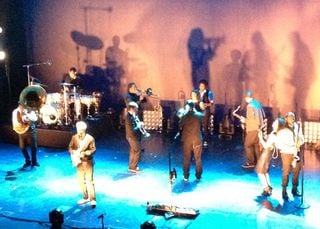
On Sunday, I caught the sensational David Byrne and St. Vincent show at the Orpheum Theater with my friend, HubSpot CEO Brian Halligan. Regular readers know I'm a mega music geek and maintain a spreadsheet with, as of this writing, 518 bands I have seen in concert since I was 16. The David Byrne and St. Vincent show was top ten. Really. It was that good.
Consulting my spreadsheet, I see the last time I saw Byrne live was when I caught the Talking Heads on August 19, 1983 at the old Forrest Hills Tennis Stadium in New York City. Here's the NYT review of that show.
How Music Works
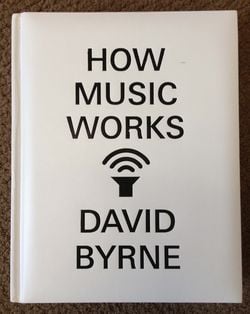
The other part of David Byrne week is his fabulous new book How Music Works. The book is Byrne's take on the industry he's succeeded in. He offers keen observations about the music industry, the art of making music, telling stories in the book using a combination of history, anthropology, and music theory. I love this book!
In particular, Byrne has a fascinating take on the development of music, which is quite different from what other music historians say. In a chapter titled "Creation in Reverse" he argues that music evolves to fill the space where it is performed.
For example, the Talking Heads evolved in the 1970s at New York punk club CBGB requiring volume to overcome the din. The sparse music that came out of the CBGB scene such as the Ramones and Television worked perfectly for that room.
Music that evolved in gothic cathedrals (lots of reverberation) has long notes with no key changes. Carnegie Hall and other similar rooms require texture. With discos, people made music to exploit the fantastic sound systems and people’s need to dance. Rock music played in hockey arenas (the worst acoustics on the planet) must be straightforward with medium tempos. You get the idea. The music that is successful works perfectly for each venue.
With personal sound systems (starting with the Walkman in the 1970s then evolving into MP3 players such as the iPod), all of a sudden you can hear every single detail. This allowed pop music to evolve from its early radio form.
Here is Byrne's 2010 TED Talk on this idea: How architecture helped music evolve.
How Content Works

As I devoured How Music Works I was constantly thinking how Byrne's ideas apply to other forms of content. These ideas are very important for content marketers.
As I see it, success using the different forms of online content is evolutionary to the way the content is consumed. The best content evolves to fill the new media (such as blogs, YouTube videos, Tweets, photo sharing, and the like). Each new way to create content means a new form of content is best suited for the media.
This seemingly simple idea has wide ranging application for marketers and helps explain why some content succeeds and others fail in new environments.
Here are a few specifics:
Distribution: Prior to the Web, creators expected the production and distribution of content to be expensive. You had to print things on paper. You needed to buy film and develop images. You needed to pay to send your stuff in the mail or over the airwaves. With the Web, all of a sudden the cost of creation and distribution falls to zero. For that reason, the quantity of content exploded. People were much more tolerant of less than perfect content. The evolution meant that casual videos worked on YouTube and you didn't need a $50,000 production budget. Blogs without professional editors built a following. The content evolved to fill the medium.
Registration: With the sharing of long form content like white papers and ebooks, nearly all marketers started offering their stuff the same way they did offline – with a requirement that you have to register to get the document by filling out a form with your email address and other personal information. After all, marketers said, that's what we did offline. But doing that is like playing The Ramones in a gothic cathedral. The content doesn’t fit the venue. When Seth Godin and a few others pioneered the offering of valuable content like ebooks completely free with no registration, a new model that fits the environment of sharing on the web was born. It turns out people eagerly share free content driving the number of views. The content evolved to fill the medium.
Instant: When Google started indexing content for Google Search in real-time, it transformed how information is found. For example, this blog post was indexed by Google the second I posted it. Yet this profoundly important concept is widely misunderstood. Because search engines used to take months to index new content people didn’t have to be quick to post about breaking news. My ideas around Newsjacking were focused on how blog content is slowly evolving based on real-time indexing. Just like how music evolved with the Walkman, content is now evolving to fit with real-time indexing.
David Byrne's How Music Works is amazing. Read it. And as you do, substitute "content" for "music" and see where the ideas lead you. Share them here if you'd like.
Disclosure: How Music Works links to the Amazon Affiliate program.


David, great insights as usual. There are a couple more specifics to add to your list:
Bite size - content distributed in blogs, Youtube videos and eBooks tends to be shorter, more direct and written and produced quickly. Content is being produced in bite-size chunks, rather than in long-form. There are a few exceptions to this, but not many.
Visual - every blog post includes at least one, and often two or more visuals. eBooks are full of visuals. One only has to look at the difference between one of your early books and your latest (Newsjacking) to see the difference.
JIm
Posted by: Jim Ewel | September 26, 2012 at 05:47 PM
Great post David. I also want to add that Content should also be relevant and transparent otherwise it will not be liked and shared.
Posted by: Larrywaight | September 26, 2012 at 06:04 PM
Jim -- good points. My list wasn't meant to be comprehensive, so thanks for the additions.
Larry -- absolutely!
Posted by: David Meerman Scott | September 26, 2012 at 06:36 PM
Excellent! I always vouched for the idea to find the pattern from other forms of good content ...especially music... unpredictable layers of sound made me experiment with layers of video for my On-Air Promotional work and in fact most of the times both mediums complimented each other magically!!! thanks for the recommendation... will certainly grab a copy of this book
Posted by: Brijesh | September 26, 2012 at 10:38 PM
Thanks Brijesh - I've been searching for those patterns for a decade. It is really fun!
Posted by: David Meerman Scott | September 27, 2012 at 04:50 AM
Definitely the next book I will be reading!
I always find it curious when people are always asking for something in return when you don't even know them. I guess the best way is to give something away like an e-book and earn their trust gradually!
Posted by: Rj_c | September 27, 2012 at 09:41 AM
David,
Thanks for relating marketing to rock as you often do.
It is a constant battle between opt-in marketing vs Seth Godin/David Meerman Scott schools of no opt-in for free ebook. Most marketers say building the list is valuable, whereas you might say letting idea go viral is more valuable.
I'm still in the middle of those two schools of thought. Your evolved/recent thoughts?
Posted by: CareerPlanPro | September 27, 2012 at 11:22 AM
Rj_c - exactly. It's like asking for a woman's phone number in a bar before you've met her. Sometimes it works. Usually it doesn't. And occasionally you're slapped.
Posted by: David Meerman Scott | September 27, 2012 at 11:23 AM
CareerPlanPro - I like the hybrid model of making all content free but at the end of the content having a secondary offer (such as registering for an email newsletter or a webinar)
Posted by: David Meerman Scott | September 27, 2012 at 11:31 AM
Great stuff David.
I especially like your thinking about reading and substituting the main word with your word.
You suggested substituting "content" every time David says "music."
Since I focus on associations and nonprofits, I've spent that last few decades urging colleagues to substitute the word (music, business, company) with "association" ... so they can see the full impact of what trends translate to the nonprofit world.
Appreciate your insight!
Steve
Posted by: Steve Drake | September 27, 2012 at 11:54 AM
Steve - glad it helped. It is a terrific book.
Posted by: David Meerman Scott | September 27, 2012 at 12:26 PM
The article is very good and I learned many useful and interesting Nea who until now did not know. I follow your site often and loving much. Always there are many useful things for beginners.
Posted by: Daniel | September 30, 2012 at 02:09 PM
David... I am a big fan of the free model for content with no registration. So why does Hubspot, with whom you work, require an registration for its ebooks?
Posted by: Pamela Atherton | October 19, 2012 at 03:10 PM
Dear David:
Thanks for the book referral. I'm off to order it.
Your writing brought back memories of Harvard Square's Club 47 days.
BTW, have you ever encountered Daniel Levitan's This is Your Brain on Music: The Science of a Human Obsession?
http://www.amazon.com/This-Your-Brain-Music-Obsession/dp/0452288525/ref=sr_1_1?ie=UTF8&qid=1350690277&sr=8-1&keywords=this+is+your+brain+on+music
Don't let the title put you off: it's a spectacular book that explores musical themes in all genres from a neuropsychiatrist's point of view.
I think you, and anyone else with catholic musical tastes, would really enjoy it.
Posted by: Roger C. Parker | October 19, 2012 at 07:49 PM
Pamela - there are different points of view on content registration. HubSpot offers many, many things for free. And some they require registration.
Roger - Yes! I have read that book. And Oliver Sachs has some interesting books on the topic too. I think you will like Byrne's stuff.
Posted by: David Meerman Scott | October 20, 2012 at 07:30 AM
David, what an awesome insight into the world of internet marketing!
I'm just wondering how many people here are really aware of the fact that it's not enough to just have the desire and willingness to make money on the web through let's say, selling ebooks but also the right mindset too.
Well, I'm actually writing this now in hope to inspire or intrigue somebody to wonder what it really takes to become a super successful millionaire internet marketer that many probably find their ever desired dream like I do.
After my 7 year long painful and agonizing drama full of tears and "cries for help" when trying to figure out how I could make tens of thousands of dollars a month online by selling ebooks, I am glad to tell you that I have finally "unlocked the code" of winning the game of making money online.
Subsequently, after years of hurting trials a nd errors and disastrous failures I have realized that the key to making money online lies in the combination of adopting the right entrepreneurial mindset, being productive through practicing a set of good, productive habits and finally understanding and implementing the right internet marketing strategies when it comes to drawing traffic to your website or blog and then monetizing or cashing in on that traffic.
It is as simple as that. And, yet we still see many people are still wasting their time sitting on major social networks to chat with their friends instead of asking themselves:
"Wait a second, I am now on facebook connected with another 20 million users. What would it look like if I could come up with an idea to setup and form my own social community around our common interests or passions and see if I could potentially recognize a desperate need or desire among the members of that community for solving a certain problem that I could easily solve?"
With the exactly same kind of thinking as I've just described and after I've actually got properly shaken with a life-changing Wake-Up call not to be a time waster in my life any longer, I've recently setup my own personal blog.
What kind of online presence you have?
Are you aware of the opportunity that the internet give both you and me to each become brands like Coca Cola and Disney now in the matter of months and not years or decades as it used to take in the past, if we simply make a little bit of effort towards spending our time online more productively and thinking of great earning possibilities that the internet is offering us?
Posted by: Bruno Babic | October 29, 2012 at 01:56 AM