



I'm presenting at the LinkedIn #B2BConnect 2012 event today - April 17, 2012 - in Mumbai, India.
A few weeks ago as I was preparing my talk, I asked my friends at HubSpot if they had any data on the effectiveness of LinkedIn that I could share with my audience. Rebecca Corliss came through with some awesome new data which I am releasing for the first time here.
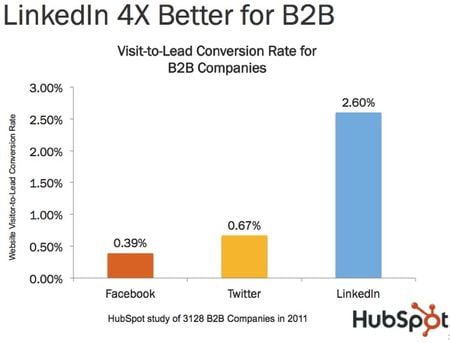
In a study of 3,128 HubSpot B2B customers, LinkedIn generated the highest visitor-to-lead conversion rate at 2.60%, four times higher than Twitter (.67%) and seven times better than Facebook (.39%).
The methodology was a data dump of all of HubSpot customers' social media traffic and leads collected through the HubSpot system in 2011. From there, data was segmented to look at B2B companies that had generated visits and leads from social media. Companies that generated less than two leads in the year were excluded from the sample.
Lead generation with LinkedIn
This data clearly shows that LinkedIn is a good lead source. But few B2B companies use LinkedIn to its full potential.
To help you, HubSpot has published a free ebook Learning LinkedIn From the Experts: How to Build a Powerful Business Presence on LinkedIn. In it, five LinkedIn specialists provide insight into how you can use LinkedIn to successfully grow your network and business. Or just check out the HubSpot LinkedIn company page to see the potential of what LinkedIn can do.
Disclosures: I am on the HubSpot board of advisors and I serve as Marketer in Residence for the company. I am being paid to speak at the LinkedIn #B2BConnect 2012 event.


I wish several companies I know would read this post. I think Facebook for B2B or corporate environment is as useless as Linkedin for sharing your social life... and as useless as using a fork to eat soup. You must choose the right tool for the right audience (I published some similar ideas on my blog)
Unfortunately Facebook is very trendy, so many think they must use it...without thinking if it will work for their strategy (in the case the had any) or not.
Great post. Thank you
Posted by: Antonio Calero | April 17, 2012 at 02:44 AM
Great data that supports what I've been telling people in presentations about building professional profile. Facebook may have a role in B2B, but it's nothing like the go-to resource that LinkedIn is.
I posted on this today on my own blog, theIdeaStudio: http://www.customercrossroads.com/customercrossroads/2012/04/which-social-network-can-get-you-business-linkedin-is-for-b2b.html Thanks for the inspiration!
Posted by: Susan Abbott | April 17, 2012 at 11:38 AM
I find Facebook and Twitter to be more fun. However, when I'm serious about networking for business, I definitely head for LinkedIn!
Posted by: Tamara G. Suttle, M.Ed., LPC | April 17, 2012 at 10:27 PM
LinkedIn is seriously under-utilized as a marketing tool. Its groups and answers features give marketers more information than you could ever glean from Twitter profiles or Facebook open graphs. There are people asking questions and telling your their problems every single day! I've consistently found that (for me) LinkedIn converts 10x to 20x better than Twitter. The volume is about half so that still results in a net 5x to 10x increase. It's because the responses are laser-targeted and customized. People don't like to do it because it takes better organizer and more work.
I've just launched a new web business 30 days ago and so far LinkedIn conversions are 12x better than Twitter and 2.9x better than Facebook.
Posted by: Jon DiPietro | April 18, 2012 at 08:20 AM
Hi David,
I'd agree i might be more than 4 maybe 6 or 7 times more effective for B2B. I think it is if you establish some thought leadership their through groups. If your using it as purely Sales tool I think you'll have a tougher time.
My friends Sales friends at Cisco our using it as Sales Channel. I personally think if you are you should give back a bit maybe go pro or establish the leaderships I talked about. I think that will reel people in more.
Thanks
Dara
Posted by: Dara Bell | April 18, 2012 at 03:17 PM
Thanks, David. We've had a lot of success with LinkedIn and I think it's because it's used for professional development. We market software tools for engineers, so there's a symbiosis with our user community: our tools are enhanced by skilled users and skilled engineers are are enhanced by our tools. In other words, without a skilled user we are just dead bits on a hard disk drive. We hosted a Group on LinkedIn so that our community can showcase their skills and develop their careers. They can tag their profiles/resumes with our tag, and attract headhunters who are looking for the skill to drive our tool. It's a win-win-win! PS Thanks also for the mention! :-)
Posted by: Signalintegrity | April 18, 2012 at 07:40 PM
I think there are practical applications for all the major social media platforms, but LinkedIn has some obvious (and not so obvious) advantages in business. As a corporate blogger, I pay very close attention to who responds to the material I share everywhere but especially on LinkedIn.
Posted by: Crystal Wiebe | April 23, 2012 at 10:39 AM
I understand that LinkedIn is better for B2B lead generation because it is a professional network. However, that kind of makes the conclusion fall into the category of "Well, duh!" Business people use LinkedIn for maintaining business connections, not Facebook.
However, we should stop thinking of paltry visitor-to-lead conversion rates of less than 3% and start thinking about connecting buyers, sellers and vendors through the power of those networks we all possess and put systems in place to manage it all as a virtual channel. Many B2B products, especially long tail/niche technology products need to be sold. No one will click to buy 40 grand worth of Active Directory utilities off a LinkedIn ad. But sales like that are too small or too expensive for a direct sales force.
Let's look beyond the irrelevant conversation of Facebook vs. LinkedIn for B2B and look at how social networks can be used to get B2B products to market in fundamentally new ways.
Posted by: Tim Johnson | April 26, 2012 at 02:37 PM
Tim, I absolutely agree. And I've been writing about that topic for a decade now (since 2004 on this blog). Nevertheless, I do think this is interesting data. Thanks for jumping in.
Posted by: David Meerman Scott | April 26, 2012 at 02:44 PM
David, would you be willing to have an offline conversation about a system that is just coming on the market that can do just that?
Posted by: Tim Johnson | April 26, 2012 at 11:28 PM
Thanks for the post. Can you define "visits" in the context of this research? Is it one visit to a company page on LinkedIn, Facebook or Twitter? On LinkedIn you could also visit a group or a personal profile, correct? Hence the request for clarification. Thanks!
Posted by: Curiousbanker | May 01, 2012 at 09:44 AM
Thanks for this post, I quoted it on my blog : http://www.mailinblack.com/blog-mib/br%C3%A8ves-mib-%E2%80%93-30042012 ;)
Posted by: Hadia | May 02, 2012 at 03:30 AM
Certainly an interesting stat, but:
Just a flat data dump of where inbound traffic came from
No consideration for how they were encouraged to click through
No analysis of calls to action vs links from info page vs links in signatures vs...
Prospects on each of the services need to be marketed to differently. Without the above information, the stat is just a stat and not something to trust as a guide.
On the surface, the numbers are really just a "Duh!." Linked in is targeted to businesses who want to do business. Neither Twitter or Facebook fit this model. I would suspect the same concept with point to Facebook as the leader if your conversion metric was number of attendees at a social event.
So, is this truly relavent data, or just more internet information clutter? Frankly, I find it to be content that is void of usable information, and another fine example of HubSpot link-bait.
Posted by: John | May 03, 2012 at 10:37 AM
John, all data tells us something and all data leads us astray. It is the nature of data.
If data shows that 80% of marketers do something, does that mean you should do it? Or avoid it because it is too common?
I find HubSpot data interesting and so do many others.
Posted by: David Meerman Scott | May 03, 2012 at 03:08 PM
@John - Rebecca from HubSpot here. This data is not looking at traffic. It's looking at visitor-to-lead conversion rate, ie on average what portion of traffic from the source converts into leads (via a form) for businesses. I agree with you, a dump of traffic data wouldn't be as telling.
We think data like this is valuable for folks who are trying to decide which channels to prioritize when the goal is lead generation. I also would argue Twitter and Facebook can fit the lead generation model, but can be more challenging. You have to direct people to landing pages via CTAs in a natural, non-forceful way.
Thanks for your comments. Good stuff.
Posted by: Repcor | May 03, 2012 at 03:23 PM
LinkedIn is a truly great way to connect with other professionals in the same industry. LinkedIn allows you to join groups that are relevant to your business, as well as promote events with others in the industry that you may not be able to reach otherwise. Similar to other forms of social media – if businesses are not utilizing LInkedIn to its full potential, they are surely missing.
Posted by: Cygnis Media | May 15, 2012 at 02:13 AM
The information presented in the study (inspired by David Meerman Scott and conducted by Rebecca Corliss) was a B2B data subset of all of HubSpot customers’ social media traffic and leads collected through the HubSpot system in 2011.
Posted by: www.amsfulfillment.com | June 16, 2012 at 06:09 AM
This is a really surprising data from HubSpot . LinkedIn has now surpassed Facebook and Twitter. A 2.60% visitor to lead conversion rate is something very high. Every marketer will be looking at such results. Many people are of the assumption that only Facebook is the real way to generating leads.
Posted by: FeliciaCorrine | June 22, 2012 at 04:36 AM
"LinkedIn generated the highest visitor-to-lead conversion rate at 2.60%, four times higher than Twitter (.67%) and seven times better than Facebook (.39%)." These statistics are very, very interesting! They will significantly change some of my marketing plans.
Posted by: Gary Brock | September 02, 2012 at 12:01 PM
LinkedIn generated the highest visitor-to-lead conversion rate - I believe this is why LinkedIn is considered a successful marketing strategy. It's probably because the power of social media which is to influence and gather information is utilized by marketers in a way that they make the best of people's curiosity and problem-sharing.
Posted by: Cyrus Lane | February 12, 2013 at 03:46 AM
I find LinkedIn useful in businesses, because it's my information-gathering tool. Previous commenter made a point about it being "influential" and yes, we do take advantage of people's curiosity - that's one of the ways for us to know what they want and need to know. Because of this online tool, we're able to answer their questions, satisfy them and solve their problems.
Posted by: Amy Cassie | February 12, 2013 at 04:31 AM
LinkedeIn succeeds as a marketing strategy or business tool, so now our marketers have more time to improve the financing. With all these working well, the businesses will succeed.
Posted by: Marcus George | March 11, 2013 at 09:48 AM