

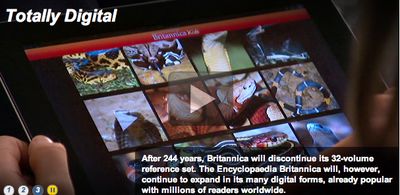
The Encyclopaedia Britannica, the oldest English-language encyclopaedia still in production, was first produced in Scotland in 1768.
The company announced it is going completely digital. If you want to pick up your very own copy, the final 2010 print set edition is available at The Britannica Store for USD $1,395.00.
Everywhere we turn there is evidence of the communications revolution.
I've often said the revolution of Web content and social media is the most significant communications revolution since the invention of the printing press.
It took centuries for the world's population to become literate. But in just a few short years, of the 6 billion people on the planet, 4.8 billion have access to online information in the form of mobile data. In fact, there are more mobile phones in the world than toothbrushes.
I've been talking about the importance of online information as a tool of marketing and PR for nearly 20 years now. For the last decade I have run my own business focused on helping companies make the transition from traditional offline marketing to online marketing and PR strategies.
In 1998, people thought I was insane to argue that marketing & PR is going to the Web.
In 2002, I was that weird Grateful Dead listening oddball insisting that the revolution is coming. That's the year I got fired from my corporate VP of marketing job partly because I insisted on the Web and didn’t agree on investing in print direct mail the way others in the company did. In 2002 I started my own company to develop strategies and write and speak about what the communications revolution means to marketing & PR.
In 2005, others began to realize we're at the cusp of a revolution. These pioneers fought the bosses and the entrenched powers and started to create content on the Web as a form of marketing.
In 2009, many people saw the power as hundreds of millions gravitated to social tools like Facebook and Twitter.
Now, in 2012, while over a billion people are engaged via social media and tens of thousands of organizations have a dedicated online content effort for marketing purposes. However, there are still many holdouts resisting the revolution.
Encyclopaedia Britannica print set discontinued after nearly 250 years
In a New York Times blog post, Jorge Cauz president of Encyclopaedia Britannica Inc. was quoted as saying: "It's a rite of passage in this new era. Some people will feel sad about it and nostalgic about it. But we have a better tool now. The Web site is continuously updated, it’s much more expansive and it has multimedia."
Exactly.
So here are a few questions for you:
- How much effort are you putting into producing brochures and other print materials?
- How about those print advertising efforts?
- How's that print direct mail campaign going?
- What's the budget for Yellow Page ads?
- What about your resume?
We're in the middle of a profound communications revolution.
Are you on the leading edge? Or are you clinging to the way we communicated in 1768?
Images via britannica.com


Hi-tech progress goes mutch faster than i can read...
Posted by: write my thesis | March 14, 2012 at 08:15 AM
The knowledge of the world increases every second and I think it is very challenging to keep up with this development with a printed publication.
Posted by: Dragan Mestrovic | March 14, 2012 at 09:21 AM
Wow! Rite of passage indeed. I hope Wikipedia has a good disaster recovery backup! Also I pity an archaeologist 4,000 years from now trying to decipher the magnetic domains on an unearthed hard disk drive. It will make Ventris and Chadwick's decipherment of Linear B look like child's play!
Posted by: Colin Warwick | March 14, 2012 at 09:29 AM
Thanks David. Whilst a little nostalgic for E Britannica, am so excited about the new era they're now entering. The technology has transformed the marketing landscape as you indicated way back in 2002 --because it changed our customers' behavior.
Great post! And big congratulations on your ten year anniversary! Cheers!
Posted by: Anne Sorensen | March 15, 2012 at 05:07 AM
it is amazing how fast things are growing now a days it is so hard to keep up with technology.
Posted by: Andrew | March 15, 2012 at 07:23 AM
Anne - thanks for your support over the years. I appreciate having a kindred spirit in Australia.
Dragan & Andrew - Yes. It is amazing how quickly we've come this far!
Colin - Yeah, good point.
Posted by: David Meerman Scott | March 15, 2012 at 07:59 AM
Good reminders, David. What we continue to debate in B2B is whether C-level are going entirely digital in their consumption of info. Just heard a well-known speaker the other day qualify the digital trend with "except for C-level, of course, that's still a print message." Your/others' thoughts? Research that reconciles this point?
Posted by: Kelly LeVoyer, SAS | March 15, 2012 at 11:16 AM
David, this event further reinforces what both you and Seth Godin previously discussed about an actual physical copy of a book when Seth introduced The Domino Project. Those physical copies move to the role of "gifts," "keepsakes," or "limited-edition souvenirs."
As an example, physical books I've purchased from Amazon in the past 4 weeks serve those purposes ONLY. Everything else that I study and read is downloaded on my Kindle. Your latest success with the digital-only release of Newsjacking is a perfect example.
Furthermore, I purchased Seth's Purple Cow in physical form because I'm afraid I won't be able to get one in the near future. Same thing goes for Poke the Box, We Are All Weird, and your New Rules of Social Media Series entrant Go Mobile. These serve the role of "keepsakes" for me.
What will be interesting to see is which consumer platforms win out (but that's a separate blog post). Because, we're past the point of "content is king." It's now which digital consumer platform(s) will be king and how companies adapt in monetizing their content for those specific consumer platforms (i.e., iPad-specific, smartphone-specific, etc.)
Posted by: Tony Faustino | March 15, 2012 at 12:10 PM
Kelly - That speaker you heard is dead wrong. Everyone uses the web today as their primary tool of communication. Here is some old research (2009). I'm sure there is something newer out there. http://images.forbes.com/forbesinsights/StudyPDFs/DigitalCsuite.pdf
Tony - Yes. I should say that I am not suggesting that print is going away. It is not. I still have very healthy sales of my print books. And I subscribe to the daily print Boston Globe and a bunch of print magazines. But the ways people use digital information continues to increase.
Posted by: David Meerman Scott | March 15, 2012 at 01:07 PM
David, while I agree that digital is a preferred medium, I for one have ramped up my direct mail with huge success.
I have taken to mailing every patient that has been in my office in the last year a monthly newsletter. It has been a huge success. When I was emailing the same newsletter it was barely registering. Why?
I believe it is competition. Think about how many emails you get a day vs how many pieces of direct mail you get. Quite simply, I have less competition in the mailbox than I do in the inbox.
Posted by: Kevin | March 15, 2012 at 03:57 PM
Kevin - interesting point. You're sort of going retro. It's like sending a personally hand written email after a job interview.
Posted by: David Meerman Scott | March 15, 2012 at 03:59 PM
The main feature of the information revolution is the growing economic, social and technological role of information.
Posted by: FB Apps | March 16, 2012 at 01:01 AM
These kind of post are always inspiring and I prefer to read quality content so I happy to find many good point here in the post, writing is simply great, thank you for the post.
Posted by: Banners oklahoma city | March 16, 2012 at 06:57 AM
Here's an interesting visualization if Wikipedia was ever printed...
http://en.wikipedia.org/wiki/File:Size_of_English_Wikipedia_in_August_2010_(L).svg
In August 2010 it would have taken over 2,500 Britannia-sized volumes!
http://en.wikipedia.org/wiki/Wikipedia:Size_comparisons
Posted by: Colin Warwick | March 16, 2012 at 08:39 PM
..even more up-to-date visualization....
http://en.wikipedia.org/wiki/Wikipedia:Size_in_volumes
Posted by: Colin Warwick | March 16, 2012 at 08:44 PM
great post very interesting thank you for all the information.
Posted by: Andrew | March 19, 2012 at 08:21 AM
David, again you provide great information and context. Anecdotes like this help us explain what we do and why.
Posted by: Roy Harryman | March 20, 2012 at 10:50 AM