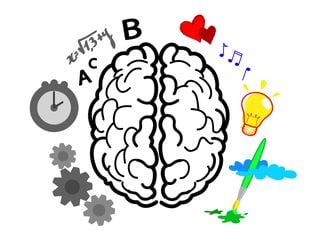

As I evaluate Web marketing such as blogs and websites, one thing I look for is evidence of both left-brain and right-brain thinking in the creation of the content. This obsession might seem trivial, but I guess my right-brain outlook on life causes me to take a holistic view of content.
The right-/left-brain concept is widely credited to have developed from the thinking of American psychobiologist Roger Sperry in the late 1960s. Sperry's Nobel Prize-winning work opened whole fields of psychological and philosophical debate including the idea that there are two different sides of the brain, each controlling a "mode" of thinking.
What kind of thinker is your buyer?
Left-brain thinkers focus on the logical, rational, sequential, and analytical while right-brainers prefer more random, holistic, and free-associated approaches.
Psychologists say that left-brainers focus on words and numbers while right-brain people focus on visual images and patterns.
In our world of creating content for marketing purposes, one might say that left-brain people make logical deductions from information while right-brain thinkers prefer to make lateral associations from information.
What right brain / left brain means for content marketing
The best websites, blogs, and social pages (Facebook and G+ for example) include a combination of text content, images, video and charts. Your goal is to create a mix so that people who are visual have an infographic or photo and those who are analytical might have text and numerical charts.
But there are two problems.
1) Most ad agencies and design agencies are populated with people who are great at creating visual content but less good at writing and other left-brain content creation. This means that while sites offer visual cues and easy-to-access lateral information few deliver words and numbers in logical ways.
2) At the same time, left-brainers dominate the top ranks of many companies. Often the top marketing person is a left-brained MBA-type. Need proof? Just count the times "MBA required" is listed on the job description of marketing people at companies. How many liberal arts graduates do you see? Some, but they are greatly outnumbered.
One organization that does an excellent job delivering content for all types of people is Amazon. There are multiple ways to find content including search, by topic, and through "best of" lists. There are videos and images and graphics.
As marketers we need to include both right-brain and left-brain people in our content creation efforts.
Finally, a note to HR executives and headhunters: Please remove the""MBA required" label from marketing jobs—you'll have a better candidate pool if you don't exclude right-brain individuals.
Image: Shutterstock / Carla Castagno


I'd like to see how social search profiles on groups of decision-makers and influencers can guide the formulation/articulation of a business case (and the language that those decsion makers are most in tune with) in a B2B service offering.
Posted by: Rich Reader | January 27, 2012 at 04:22 PM
Brian Clark just tweeted this, and I took a look. David, this is a great intro into the mix that should be used when creating things like landing pages and websites that should be funneling lookers down to clients with good content--facts/figures and visuals such as infographics and meaningful images.
I think all successful marketers need to be good at using both sides. The companies looking for MBA marketers probably want to make sure they're getting the logical along with the creative. To be honest though, I doubt the real creative marketing geniuses out there had a need to return for an MBA.
Henry
http://searchrespect.com
Posted by: Henry | SR | January 27, 2012 at 04:25 PM
Love it. I'm always working to build out personas to help drive our content - I've never really considered the two brain parts like this. And I'm a psych major ;)
Not to side track the main point of the post, but my undergrad in Psych and years working in the field (therapy, psych hospitals/research) have helped me tremendously in a marketing/online marketing career.
I'd say MUCH more than the MBA I eventually went back and got.
@davemhuffman
Posted by: Dave | January 27, 2012 at 04:25 PM
True: "People buy on emotion and justify with logic."
So need to provide both.
Louis Gudema
Vice President of Business Development
Overdrive Interactive
Posted by: Louis Gudema | January 27, 2012 at 04:41 PM
Great additions to the discussion here. Thanks to you all.
Posted by: David Meerman Scott | January 27, 2012 at 04:50 PM
As usual, the right/left brain issue is discussed as if it is a given that a person is one or the other but not both. There are even those that seem to think that strength on one side automatically means weakness on the other. As I see it, right-brained people use this thinking to justify their lack of critical thinking skills. Many famous left-brained people are also quite creative and visual thinkers. Einstein, to name just one.
Posted by: Paul Topping | January 27, 2012 at 05:33 PM
Paul - indeed.
"Not everything that counts can be counted and not everything that can be counted counts." -- sign on Albert Einstein's office door at Princeton.
Posted by: David Meerman Scott | January 27, 2012 at 05:41 PM
Another great post David..a great reminder to to limit ourselves.
It reminded me of this from one of my favorite poets - Dr. Seuss. "Think left and think right and think low and think high. Oh, the thinks you can think up if only you try."
Posted by: Toby Bloomberg - @tobydiva | January 27, 2012 at 05:45 PM
Couple of thoughts, David.
First, general agreement on the importance of covering both sides of the brain. So much so, in fact, that we trademarked our approach at Weidert Group as Whole Brain Marketing.
That being said, many writers (and copywriters!) would argue that the best writing comes from the right brain, while the best editors are left brain people. We are talking about content CREATION after all, and creation is a right brain skill.
And finally, easy on your criticism of MBAs. Fully 40% of my MBA class at Northwestern's Kellogg School were liberal arts grads. So we were forcefully developing our left brains because we knew we would need them, even thought we were more comfortable operating from the right.
Thanks again for the interesting slant.
Posted by: Greg Linnemanstons | January 27, 2012 at 05:57 PM
Leave it to @TobyDiva to quote Dr. Seuss! Thanks Toby.
Greg - Wow that's cool that you are doing much deeper thinking on this topic than me. I'll bet it is working well for you. As someone who has written 8 books (working on a 9th) I can say for sure that editors have different skills and are absolutely required.
I hear you on MBAs. I did a liberal arts degree at Kenyon and never did an MBA so my natural bias tends to come out sometimes. Still, *requiring* an MBA is silly. If a company requires an MBA, then I am personally not qualified for many junior marketing jobs. Hmm...
Posted by: David Meerman Scott | January 27, 2012 at 07:22 PM
We are in the infancy of full inclusion. Power people are spooked by those of us with other motivations! Hope you can demystify and de-panic HR folks about right-brained talents that are now sorely underutilized, leading to (as you point out above) a lop-sided product that doesn't have the desired reach. Thought provoking.
Aloha from Waikiki
Comfort Spiral
>
Posted by: cloudia | January 28, 2012 at 04:05 AM
Hey, David --
Very cool post on left brain/right brain, which is one of my favorite topics.
I'm a right brainer, but my wife, who is a former CPA, is a left brainer. My youngest daughter got lucky and is one of the rare types who is equally good with left brain (logic) and right brain (creativity) stuff.
A quick research note -- brain scans show that women have 25% more connections between their right hemisphere and their left hemisphere than men, which is why they're better with communication skills than men are.
Some would argue that also explains why they're smarter than men.
;-)
Best,
Jamie (a man) Turner
Posted by: AskJamieTurner | January 28, 2012 at 08:32 AM
You raise an interesting point David, but one that I think can be applied across most aspects of marketing not just content creation – for example, blending right and left brain signals is critical to how brands engage with prospects and buyers, and therefore the success of their sales process, because it ensures that people remain fascinated and justified as they make their way through the sales funnel.
Consumers buy emotively and explain logically, so the ability to provide them with experiences that they enjoy and talk about, and at the same time to give them reasons that they can use to explain what they are doing or to those who are influential in their lives is critical.
With a nod to Jane Austen, perhaps we can meme this simply as Sense and Serotonin.
Mark Di Somma
Posted by: markdisomma | January 28, 2012 at 04:45 PM
The left brain is judgmental. It's what keeps us from creating content that we intuitively know will resonate with people but we are afraid of going there.
You need to be able to tie the left side of your brain behind your back so the right brain can get some ideas out. You can always edit them later.
One method of doing this is to put unreasonable deadlines on brainstorming. You'll short-circuit the left brain if you have to come up with a bunch of ideas in a matter of minutes.
We've got a formal video-guided exercise that will guide you through generating a year's list of blog topics or a book outline or a business plan in 37 minutes. It's free (for an opt-in).
We developed it for clients but decided to let anyone use it.
www.shortcutblogging.com
Posted by: Dave Young | January 29, 2012 at 10:17 PM
At the risk of appearing to model the ideal after ourselves, it's my belief that the best marketing people have BOTH left-and right-brained abilities.
A liberal arts educational background is very good for this, as it trains the recipient with critical thinking skills as well as a background appreciating a variety of influences. It should however also include, either concurrently or subsequently, the analytical rigor and discipline that is typically included in a better MBA program.
Posted by: Steve Kirstein | January 30, 2012 at 10:54 AM
Interesting point about the need for both sides of the brain.
One of the early applications of Sperry's work was by Dr. Betty Edwards, Univ of CA Professor of Art in her book "Drawing on the Artist Within."
Her technique is to give the student a task so boring that the left brain will reject the task. For example, she has students turn a Picasso line drawing upside down and draw a copy of what they see. The left brain won't accept the task of drawing an upside-down face, so the right brain takes over and simply draws what it sees. And "drawing what you see" is one of the most difficult skills to teach.
This seems to support the contention that anyone can access the right brain. What's required is to give it an appropriate task.
Jack
Posted by: Jack Price | January 31, 2012 at 10:20 AM
Many recent discussions regarding target audiences et al. I must confess I hadn't considered the left/right brain issue. Now it seems obvious.
No doubt there are applications (products, brands, etc...) that lend themselves mostly to one side or the other, but in most cases the content needs to be developed for both. Option 1: Read The Long Article With Lots Of Info. Option 2: See The Beautiful Infographic.
We'll definitely add this to our thinking. Thanks for the nudge.
Bill
@billbean
Posted by: Bill Bean | January 31, 2012 at 03:39 PM
Your post is certainly one of the best source of valuable information every reader must follow. Glad to hear a lot from you soon. Keep on sharing! Thanks
Posted by: Liberal Bias | February 27, 2012 at 10:26 PM
Excellent Blog. I really want to admire the quality of this post. I like the way of your presentation of ideas, views and valuable content. No doubt you are doing great work.
Posted by: replica watches | April 11, 2012 at 08:33 AM
Develop a compelling tone of voice. Don’t assume that anyone can write amazing copy, because they can’t. If you want the best content, then you need the best writers and thinkers.
Produce something informative that people will want to read. Give your brand a personality and your business will benefit across the board, from recruitment to sales. Warren Buffett looks for businesses protected by “unbreachable moats,” and no moat is more unbreachable than a brand with a story, ideas and opinions.
Posted by: Dance | April 20, 2012 at 09:22 AM
All the blessings we enjoy are the fruits of labor, toil, and self-denial, and study.
Posted by: cannon dvd box set | May 06, 2012 at 04:21 AM
What kind of prospects does an MBA (HR) with 4 yrs experience has in Australia & Singapore?
Posted by: Human Resources | July 23, 2012 at 06:44 AM