



Would you want these guys to take care of you or a loved one?
"We have assembled surgical and clinical expertise second to none, have a state-of-the-art trauma center, developed sophisticated minimally invasive techniques, and called on innovative training and technology to ensure the highest level of patient safety and quality of care. These clinical initiatives, a thriving research enterprise and an unparalleled [Famous University]-affiliated medical education program all enable [Hospital Z] to fulfill our mission."
When I read this I don't imagine people working at this hospital have a great bedside manner. Sure it's "just website copy" but it is important.
When I deliver talks around the world, I try to include some gobbledygook from the industry or company whose people I am addressing.
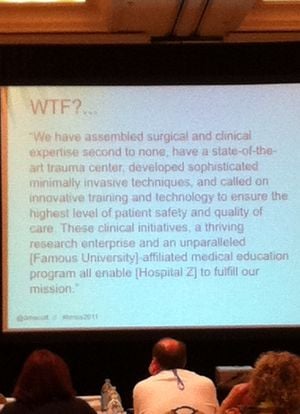
Earlier this year I spoke at the Forum for Healthcare Strategies and popped up this gem. While the slide was up, @chrisboyer snapped a pic and shared via Twitter.
The example contains the following world-class, cutting-edge, mission-critical gobbledygook:
-- second to none
-- state-of-the-art
-- innovative
-- unparalleled
Not to mention all the healthcare specific jargon contained in just two sentences.
I'm always fascinated by the words "innovate" and "innovative" which I determined from analyzing every press release sent in the English language over an entire year (there were 770,000 releases) to be the most overused gobbledygook term of all.
Let's eliminate the gobbledygook!
As Ann Handley and C.C. Chapman say in their book Content Rules, just "speak human."
The content you create is meant to build a relationship with buyers. The best content is developed through an understanding your target audience and using the words and phrases that they use. Focus on buyer problems, not your own ego or the jargon in your industry.


One of the best examples of Frankenspeak I've seen yet! Thanks for the shout, David!
Posted by: Ann Handley | October 19, 2011 at 11:54 AM
Technically, the first series is not actually parallel, i.e. "have assembled," "have a," and "developed" are inconsistant in their structure. Anybody that expects anybody to read what they write should know that elements of a series should reflect identical structures.
Posted by: Ncjks | October 19, 2011 at 01:55 PM
David this makes me so laugh at myself! When you leave the corporate world to be self-employed, (if you are not a marketing pro) marketing comes flying in your face as a major survival task. I suppose for most that's mixed up with the notion of advertising as well - another place to go astray. In my own case I was lost at sea of an idea of what to say or how to say it and still am from time to time. All the old formal, corporate, bland ways of talking come stream forward as the only way to 'be' for this task.
What I really appreciate about this digital age is just the new way of being, of building relationships, and a new way of talking. You know for a lot of people this is still very novel and I think there is almost a need to 'get permission' to get rid of the gobbledegook. Mostly I appreciate marketing industry professionals like you for so many great posts, and tools to help. Learning about marketing has never been easier than now.
Carolyn
Posted by: Carolynwinter | October 19, 2011 at 01:59 PM
As a healthcare copywriter I wade through hyperbolic, medically focused gobbledygook constantly. While I can't excuse this organization-centric marketing, I think I can explain a few reasons why it continues.
Most hospitals...
* Have no content strategy. Hospital content marketing tools--from collateral to direct mail to website copy--are almost always tactical and produced ad hoc. Rarely do hospital marketers ask: "Why do I need this tool?" "How does it speak to patient's pain points? "Is this REALLY the platform or channel that best serves the patient?"
* Don't get buy-in from content stakeholders at the beginning of the content creation process. Physicians, nurses, support staff, administrators, marketing, IT-- all have a stake in content. But they rarely communicate until AFTER the content is created. That's when they weigh in, veto and redirect, not infrequently sending writers back to start from scratch. It's at this point that--at the request of a powerful stakeholder--writers often start adding in the "innovative," "state of the art," language.
* Give doctors editorial power--and final say--over the copy. Do you want a copywriter to perform a catheter procedure on you? I didn't think so. I feel the same way about docs messing around with content. The reason the copy gets so jargony? Without being conscious of it, doctors write for other doctors--i.e., they write to impress their peers, not to build relationship with patients.
* Mistake jargon for a USP. Doctors and scientists honestly believe their training , expertise, facilities, equipment, etc., are second to none, state-of-the-art, innovative, unparalleled. They believe these attributes set them apart and differentiate them from other facilities. But in NYC, where I live, ALL hospitals and physicians are second to none, state-of-the-art, innovative, unparalleled. These attributes do NOT differentiate them. What will? Solid, strategic content marketing--loads of truly useful, patient-centric information. And social media initiatives that let patients see doctors' human side, ask questions, get answers, feel informed and empowered to make life-and death decisions.
Posted by: Lorraine | October 19, 2011 at 02:59 PM
Thanks to all of you for your very thoughtful comments.
Lorraine - yes, Thanks so much for sharing your perspective as someone who lives this. I've seen similar behavior in many industries especially financial services. While that is what goes on I think it is possible to do better. Success comes from plain language. I suggest people write as if sending a letter to their mother. As for getting in all of the stuff that the bosses want, that can still be there but in parts of the site where people go for detailed information about a particular department or procedure.
Posted by: David Meerman Scott | October 19, 2011 at 04:11 PM
I agree that hospitals and other institutions should use words that humans can understand and eliminate all the the jargon. The focus should not be to market or influence individuals with sophisticated words of car but to be genuine and really care for patients. Actions speak louder than words and it should not be about the "innovative" or "state of the art" equipment that matters. The doctors should provide each patient with the standard of care as required and be passionate about their job and patients.
Posted by: Lee Taylor | October 19, 2011 at 07:24 PM
Lee -- exactly.
Posted by: David Meerman Scott | October 20, 2011 at 05:14 AM
WE were just speaking of this in a content area meeting four our teachers (I work at an international school). We talked about the importance of knowing the jargon, but then (as Hemingway advises), being brave enough to avoid obfuscation. (Well, he doesn't there, but we get the idea.) Well said.
Posted by: Mark | October 20, 2011 at 05:45 AM
Thanks Mark. If you have any links to mission critical cutting edge school gobbledygook we'd love to see it.
Posted by: David Meerman Scott | October 20, 2011 at 06:13 AM
While we're at it, can we all stop using the word 'excited' in press releases? Every time I see it, I just know the work 'opportunity' is hot on its heels...
Posted by: Ben Locker | October 20, 2011 at 03:47 PM
Ben, the other press release one is "pleased."
Every CEO who says "I am pleased to..." sounds like an idiot to me because it is so overused. Of course it is not the CEOs fault. It is the silly PR people who insist on doing it that way.
Posted by: David Meerman Scott | October 20, 2011 at 04:33 PM
Hi David,
May I politely ask you to stop writing about gobbledygook? Everytime I read one of your posts on this topic, I receive a press release from ZyXEL stockpiled with jargon, GG and lots of other stuff I don't understand. Somehow, there must be some kind of cosmic interference here causing all of this.
As I have no influence on ZyXEL, I must urge you: do not write about Gobbledygook again!
*big fat ;-)*
Thanks again for your relentless efforts to destroy GG!
Cheers, Remco
Posted by: Remco Janssen | October 21, 2011 at 07:21 AM
Remco -- Funny you should say that. Every time I write about gobbledygook I notice more of it. I guess when you're aware of this nonsense it is easier to spot.
Posted by: David Meerman Scott | October 21, 2011 at 09:25 AM
This is indeed filled with mucho gobbledeygook.
I wonder if anyone here would be brave enough to attempt a rewrite - so we can see what something better looks like: I'm a bit frightened!
To be fair to whoever wrote this guff, I think it's easier to write simply outside your field.
If you look just at our comments on this post for example, you'll see phrases like "content strategy", "stakeholders", "collateral", "USP". These are not words normal human beings use in conversation either.
Maybe not as bad as the press release - but it does show we all get trapped in the jargon of our particular profession or cause.
ian
Posted by: Ian Brodie | October 22, 2011 at 11:54 AM
Ian, you are absolutely correct that we all have our jargon. USP? WTF!
Posted by: David Meerman Scott | October 22, 2011 at 12:41 PM
WTF? LOL.
Posted by: Ian Brodie | October 22, 2011 at 01:20 PM
Seriously though, sometimes jargon works. It marks you as an insider. Part of the community.
In this case though, I assume the target audience is potential patients - so the jargon. And much of it is fluff really, not jargon.
Ian
Posted by: Ian Brodie | October 22, 2011 at 01:21 PM
Lordy, I can't type today. I meant to say that "In this case though, I assume the target audience is potential patients (and relatives and benefactors) - so the jargon doesn't help".
Posted by: Ian Brodie | October 22, 2011 at 01:22 PM
David, you make me laugh and cause me to think. Both really good things. This past week BANG (Bay Area News Group) backpedaled on an earlier (Aug 23) announced the consolidation of 11 bay area mastheads to 2. Mack Tully's presser was captured on video and imbedded in the on-line news story. I quit watching after 3 minutes, all I could think about was "gobbledygook!" :)
Posted by: LindaMeza | October 29, 2011 at 12:33 PM
Well it does seem like Gobbledygook is a no-no..I'm pretty sure the men at the top..or at least the ones who are writing the lines for them do have the sense to know that...so why is GG everywhere?
Posted by: Sarah Samuel | October 30, 2011 at 04:22 PM