




"Stop listening to music and playing on Facebook. Do your homework."
I am doing my homework. But I work better when I multi-task.
"Did you email your friend to see if they want a ride?"
No. But I texted her.
"Twitter is not allowed on work computers."
Okay. Then I'll just have to go into the restroom with my iPad so I can tweet with my business followers.
Every day, miscommunication happens between "Digital Natives" (those born since the availability of today's technologies and therefore have native fluency in computers, mobile phones, and social networks) and "Digital Immigrants" (who have had to adapt and learn).
The culture clash can be remarkable.
In my many meetings with people in the working world, I see the culture clash first hand. The executives think from their immigrant perspective and clamp down on social networks at work. They take days or weeks to respond. They just seem out of touch.
Meanwhile, the digital natives who are entering the workforce are bewildered by the old ways of communication. They don’t answer emails. They are exceedingly casual in their communications. They just seem unprofessional.
But it doesn't have to be a world of miscommunication.
I'm convinced that corporate executives and HR people must learn how Digital Natives operate. And I also think that Digital Natives need to learn how to operate in a corporate world.
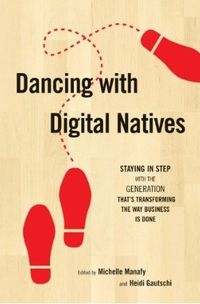
A new book of essays called Dancing with Digital Natives: Staying in Step with the Generation That's Transforming the Way Business Is Done, edited by Michelle Manafy and Heidi Gautschi is a good place to start.
Dancing with Digital Natives includes sections on Digital Natives at work, selling to Digital Natives, plus entertaining them and educating them. Some essays are written by Digital Natives themselves such as Dan Schawbel and other essays by those who work with natives.
Now when I run into fear of social media among executives attending my talks, I suggest they need to read Dancing with Digital Natives. And I also suggest to university students that they should read the book so they know what to expect in the working world.
Image: Shutterstock / Suzanne Tucker
Disclosures: Michelle Manafy, co-editor of Dancing with Digital Natives, is a friend. Now director of content at Freepint, for many years Michelle was my editor at EContent Magazine. She also edited one of my early books published by CyberAge books, the publisher of Dancing with Digital Natives.


David,
Great insight on a challenging issue facing the world of communications. There seems to be an apparent generation gap that needs to be filled and compromises/change should be made on both sides. Hopefully this new book can bring to light some ideas on how this can happen.
I see this same communication gap in the world of academia as well. As a recent PR grad from a highly ranked and industry respected public relations program, I saw "Digital Immigrants" teaching the same "Old Rules of PR" in an embedded non-changing curriculum. We were taught how to write press releases make media kits and to properly structure strategic campaigns class after 3-credit class, but there was little to no emphasis on social media, design, SEO or blogging techniques. While talking to colleagues in the industry, it seems my school wasn't the only one lacking in teaching these modern public relation practices. Just as their needs to be a paradigm shift in the corporate world of PR, I believe there needs to be simular one in the universities that are teaching and preparing the future professionals of our industry. Thoughts?
Posted by: ChaseBC85 | May 25, 2011 at 12:05 PM
@Chase -- You are partly correct. I speak with students all the time and many say that their programs are mired in the old rules.
However the good news is that a great many Universities are doing a great job. Professors like Steve Quigley at BU, Bill Sledzik at Kent State, and Karen Miller Russell at U of Georgia are just three examples. And I am pleased to say that several hundred schools use my books as texts in class.
Posted by: David Meerman Scott | May 25, 2011 at 12:16 PM
Well im glad that there has been some headway and that there are professors/Universities out there that aren't so stuck in the old ways of doing things that they dont properly prepare students for life after college. Unfortunately, I did't go to a school that thought this way or used your book as a text. I had to learn on the fly upon graduation. Regardless, its an exciting new world of PR out there and I am doing my best to keep up That in itself keeps me plenty busy.
Posted by: ChaseBC85 | May 25, 2011 at 01:27 PM
David,
My 11 year old - this is true - just told me he setup a 'business' email account.
Ivan
Posted by: Ivan Walsh | May 25, 2011 at 03:17 PM
Ivan -- Wow. Very cool. My daughter started blogging at 16.
Posted by: David Meerman Scott | May 25, 2011 at 04:48 PM
This is so true of the kids coming up these days. I get two text messages/day from my 10 year old niece, one that says good morning and one that says good night. It's simply how they connect. Now if this book would just be available for my Kindle, I'd love it! :)
Posted by: Kathy Nicholls | May 25, 2011 at 11:22 PM
David,
I am continually inspired by your words!
This new title of Danicing with Digital Natives is especially timely.
It seems there is much to learn on both sides. You are so wise to encourage young people to read it so that they know what to expect in the "Working Arena".
I think it is Awesome that we can ALL Text as we can stay so much more connected with the younger generation.
Thanks again for your insight............
Posted by: Deb Saviano | May 25, 2011 at 11:47 PM
Thanks Deb & Kathy!
Posted by: David Meerman Scott | May 26, 2011 at 05:15 AM
David,
Love your insights and both this book and your post are needed. I see an increasingly digital divide between the Gen-Yers and the older generations (and I am a Boomer). The misunderstanding of new media and new ways of working cross-tasking versus multiple-tasking are making the generation gap even wider.
It is a two-way street and as leaders in organizations we should set the tone that there needs to be communication about how we can work better together. The Gen-yers tech skills and way they work can be powerful additions to our workplaces and they can learn a lot from the wisdom and experience of the 'older' generations. In order to accomplish this, we must be intentional about building the win-win strategies to merge these two 'culures' together.
Thanks!
Posted by: Tom Hood | May 27, 2011 at 07:05 AM
Tom - thanks for jumping in.
Actually, Gen Y is not really the problem because most of them are also digital immigrants (they were born in the 1970s and 1980s).
The group that is really different is Generation Z (born in the 1990s & 2000s) the oldest of this demographic is now 21. Most Gen Z types don't know a world without computers or the Web or cell phones.
Posted by: David Meerman Scott | May 27, 2011 at 08:42 AM
Hi, Michelle here--one of the books contributors and editors. First off all: Thank you, David, for reviewing the book. It comes as absolutely no surprise to me that you understand both the challenges and opportunism presented by this generation. Now, let me chime in: Chase The book does include a section on educating the Digital Native. My co-editor, Heidi Gautschi, teaches in universities and she and other contributors to the section bring some excellent insights into how to engage, mentor, and learn from this generation. Ivan I love stories like this! I do think, though, that as much as they have a natural inclination to use and facility with digital technologies that it is important that we continue to be mindful of our role as mentors. Remember how once we had to teach young college grads how to write a "professional business email"? The use of digital communication doesn't eliminate the need for us to embrace our responsibility to help make the most of what they have to offer. Kathy: The book will be out on Kindle in June. Sorry for the delay! Kathy & Deb: Agreed! We need to embrace these wonderful opportunities to get and stayed connected. And Tom: David does have a point that the Digital Native generation is generally defined as those born since 1985. However, there are a vast array of variables at work there because ultimately, it is those raised on and around nearly ubiquitous digital technologies. Thank you all for your interest in the book and this topic. http://bit.ly/dwdnMM
Posted by: Michellemanafy | May 27, 2011 at 09:54 AM
Thanks for jumping in Michelle. Great book -- thanks for doing it.
Posted by: David Meerman Scott | May 27, 2011 at 11:46 AM
Great review and the book sounds fascinating and right on. Had to laugh because my 10 year old daughter is always texting me on her ipod touch and skyping me while I'm on the road or at the office. Sometimes even at home! It's amazing how the rules keep changing and innovation creates new work environments and challenges. A fascinating look at the clash can really be found in the financial services arena. Most of the firms will not allow anyone to interact socially on sites and yet the web, blogs, videos and podcast are such a powerful tool to educate. They are basically stuck in the stone age afraid to allow anyone to communicate any way that is not controlled. Thanks for all you do David for bringing such right on information and timely resources such as this book!
Posted by: Bryanbinkholder | May 27, 2011 at 10:01 PM
Loved this post! We have two sons, one in high school and one in middle school. Both are good students. They are nice kids who have no trouble engaging in conversations with adults. Despite these admirable qualities, the digital divide is a constant challenge to all adults our kids encounter (including my husband and myself). Many of us simply don’t get what is happening to the firm ground on which learning and communication was based for the majority of our lives. We try to understand what’s going on with our kids and embrace new technologies (i.e., I love texting, Twitter, Facebook and LinkedIn), but our understanding falls short because – unlike them – we are not fully digital. As we recruit younger "digitally rewired" workers, those of us with a firmly analogue past will have to keep stretching to close the digital divide. We will have to accept the "rewired" workforce of our future as the brilliant, creative, yet different-than-us folks they are certain to be.
Posted by: Trish Fischer | May 28, 2011 at 02:10 PM
Thanks Bryan.
Trish -- in my experience we just need to let the teenagers run with it. My daughter is just about to graduate from high school. We'd see her with headphones in, on the computer, with the textbook closed. Never once did we ask her anything like "what are you doing" or "have you done your homework." Yet she developed a style of work that was incredibly effective.
Posted by: David Meerman Scott | May 29, 2011 at 06:51 AM
I do think this goes both ways. Yes, we immigrants need to understand what is happening in the current environment as it pertains to how to communicate in this new digital world. However, the natives need to understand the formalities of business communications. Most of the immigrants still control the money and therefore control the dialogue.
Posted by: Stephen Eugene Adams | May 31, 2011 at 09:36 PM
Stephen -- Indeed it does go both ways.
Posted by: David Meerman Scott | June 01, 2011 at 05:28 AM
A good post once again buddy.It highlights the importance of communication in this digital world.I would be also looking forward to get a copy of the book (Dancing with digital natives).
Posted by: hobby | June 02, 2011 at 12:40 PM
Great post exploring the behaviours of digital natives. I've found that it works well to engage digital natives in their comfort zone --- digital mediums.
Posted by: Digital Native | October 20, 2011 at 03:03 PM