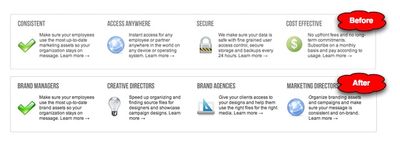

Geir Freysson, CEO of Transmit, an Icelandic software company tells us that applying a buyer persona based approach to the homepage for his Brand Regard site resulted in a three-fold increase in the number of people clicking through to the landing pages!
Brand Regard went from feature based information paths:
Consistent
Access anywhere
Secure
Cost effective
To buyer persona based information paths:
Brand managers
Creative directors
Brand agencies
Marketing directors
That simple switch, with all other aspects of the homepage being the same, made all the difference.
This is a terrific example of what I’ve been saying for years – nobody cares about your products but you. Instead, people care about themselves and solving their problems.
I asked Geir for his advice to others who want to implement a buyer persona based approach:
“Test against different types of content: Are your buyer persona links performing better than some other content that could be a better use of your screen real-estate? For us the answer was yes.”
“Track specific persona clicks: Which ones are getting the most clicks and conversions? This can be valuable market research.”
“Test different personas: We only have room for four in our design but our buyer persona research is an ongoing process and we'll be testing more personas to see which perform the best for our specific market, brand asset management.”
“If you have lots of personas, include a generic one so that every visitor will find a link that appeals. If your personas are too specific an unknown persona might visit your site, not find a link that appeals and leave.”
Nice! Congrats Geir. And thanks so much for sharing your success.


Hello David,
Thank you for sharing a great story. A good story of how organizations willing to make the time and investments in buyer persona research and development can reap significant benefits. Congrats to Geir Freysson also and many thanks for sharing!
Tony Zambito
Posted by: Tony Zambito | April 15, 2011 at 05:29 PM
Thanks for a terrific example of buyer personas David. I want to underline one point about this site -- what makes it work is the specific and well-targeted persona-based message associated with each navigation option. I'm seeing lots of companies stop short of this step and just put the job title/role on their home page. Their results are not good.
Buyer personas click through because they see their issue so clearly identified, and trust that the next step will bring them closer to a solution. Whether you're targeting one persona or four, the key to reaping the rewards of buyer personas is to say something simple and meaningful to them.
Posted by: Adele Revella | April 15, 2011 at 06:39 PM
Hi David.
Thanks for the detailed write-up of our landing page optimization results!
I hope our experience will encourage others to try out the buyer persona strategy in their own marketing.
Also, your book has been very useful to us and we're busy implementing lots of other ideas and strategies you discuss in it.
All the best,
Geir.
Posted by: Geir Freysson | April 15, 2011 at 08:15 PM
Tony - thanks. Geir did a great job.
Adele - Always great to hear from you, my friend. Indeed many companies only scratch the surface with buyer personas and just MSU "make stuff up" (substitute another word in the "S" position if you want). Geir made it work because these were real buyer personas.
Geir -- Kudos on your success and thanks again for sharing with us. I'm thrilled that my book contributed a small part to your thinking around these ideas.
Posted by: David Meerman Scott | April 16, 2011 at 06:56 AM
So interesting. I've sat in many marketing and web dev meetings, and recommended that we organize messaging around audience and not product. Address real people's real needs.
And sadly, what I have often heard back is, "We can't [or don't want to] be everything to everyone."
The result is often to dilute the message (and site structure) and play to the least common denominator. Truly an "old marketing" approach to a "new marketing" technology.
Clearly, this is a great case study to show that you can actually serve multiple audiences simultaneously without diluting your message. Or its impact.
Posted by: Daniel Waldman | April 16, 2011 at 10:37 PM
Daniel -- the issue you are facing is that the people in your company are egotistical. They actually believe that people care about your stuff. They don't -- they care about themselves. Making the transition that Geir has done will help you.
Thanks for sharing your thoughts.
Posted by: David Meerman Scott | April 17, 2011 at 07:10 AM
Thanks for sharing your experience over here.. We have learnt from this blog.. Whatever it is when we start business first strategy is very important to everyone.. Really awesome post..
Posted by: aluminium kozijnen | April 18, 2011 at 06:21 AM
Thanks for sharing-- I'm new to this and there seems to be a boat load of information available. It will take me some time to figure this out but I'm determined to do so. No time like the present to get started. I've sat in many marketing and web dev meetings, and recommended that we organize messaging around audience and not product.I had been reading a few of the articles right here but everyone provide great information and I needed to leave just a little remark to support a person as well as wish you a good continuation.
Posted by: Business Plan | April 18, 2011 at 07:42 AM
Very interesting post and I appreciate Adele Revella's comment.
I've also seen well targeted personas as a great way to help visitors navigate. But this post helps quantify the potential benefit. It seems to be very complementary to traditional navigation.
Posted by: Myron | April 21, 2011 at 02:03 PM
Very interesting article David. But the sad reality is most of the business really don't practice this. They still want to highlight what an amazing product they have rather than what it can do for their customer.
Posted by: chandani | June 08, 2011 at 12:33 PM