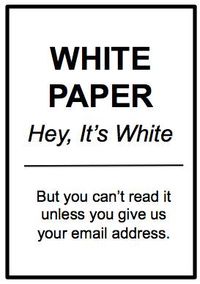

One of my favorite riffs is: "Ebooks are the hip and stylish younger sister of the nerdy white paper."
When I deliver the line to B2B marketing or technology audiences, it gets a lot of laughs.
But there are also a few people who are incredulous. Their body language says: "How can David be so rude to white papers?"
I wouldn't say I am totally dismissive of white papers. However, I do not agree with how white papers are typically used, which is why I talk so much about the ebook as different.
I've found that it is nearly impossible for marketers to get out of their bad white paper habits. Therefore, I prefer suggesting they do something completely different – an ebook.
Here is why readers do not like white papers:
- White papers are usually boring. (Hey, they're white). In fact they are so boring that most people don’t want to read white papers. Instead they feel they have to read them.
- The portrait orientation of a typical white paper does not work on a computer screen. It either frustrates readers or forces them to print out the document.
- Most white papers require registration (and therefore are used as lead bait instead of true information delivery). The forced registration sets up an adversarial relationship with the reader. The give (email) to get (white paper) is a transaction.
- Because of the registration requirement, very few people blog or tweet about white papers (because they do not want their readers to be hit with unwanted emails or sales calls). Therefore white papers almost never go viral. But an ebook like, say, What Matters Now has been downloaded probably a million times.
- White paper content is frequently just re-hashed product information designed as a "problem-solution" narrative. When you promise to deliver valuable content written in an interesting way and then prattle on about your products you annoy readers.
- Most white papers use too much gobbledygook -- the flexible, scalable, cutting-edge, mission-critical, world-class, innovative sort of words.
I admit I'm being a bit lazy.
It's too difficult to convince people to change the way they do white papers. So instead I am a cheerleader for ebooks.
Here are a few ebooks to check out:
Amdocs
On the Journey to Promoting Loyalty with Prepaid Customers
Microsoft
Tell a Story, Become a Lifelong Learner
Melbourne Federation Square
Fed Square Cookbook
Max Trescott
Learn to Fly
Vitamin Global
The 6 Essential Elements to an Exceptional Shave
I'm willing to be convinced. Anyone got a great white paper they want to share?


Great article, with useful information - and great examples.
I suspect that many B2B marketers stick with the old ways because they are talking/writing to themselves or their competitors - not the target reader (usually the customer or prospect).
The idea behind most white papers is to introduce pattern interrupt: get the reader thinking about new approaches, new solutions to their business problems, etc. That's why it is so puzzling to me that marketers stick with an outmoded form factor (the front door to their stories) and use "white writing" (blandified, turgid language that makes them sound like everyone else). ZZZZZZZZZZ.
Posted by: JLBrown | June 04, 2010 at 07:13 AM
I especially like your point about "white papers rarely go viral."
It seems to come down to your business goal: do you want to set the information free (and make it up on volume), or does gathering [semi-]qualified leads make more sense? I elaborate here: http://karlsakas.com/white-papers-rarely-go-viral-david-meerman-scott/
Posted by: Karl Sakas | June 04, 2010 at 07:32 AM
JL and Karl - thanks for adding to this discussion. Karl, you were way fast on writing that blog post. Wow!
I think part of the issue is that white paper marketing was invented decades ago and was originally print only. But the the tried and true techniques were just transferred over to a new media (the web).
Posted by: David Meerman Scott | June 04, 2010 at 07:46 AM
I can't recall reading any white-papers as of late but I can point out a ton of ebooks! Heck even I just wrote one interviewing 8 top real estate bloggers on their methods and successes (~43 downloads day one and ~87 for the week).
Posted by: Ricardo Bueno | June 04, 2010 at 07:51 AM
David:
You forgot the 'hire a great designer' part of the eBook equation!
Doug | www.eymer.com
Posted by: doug eymer | June 04, 2010 at 08:35 AM
The whole thing about getting email addresses to followup. So if we don't have the followup mechanism, wondering if you've seen evidence that people tend to start following you on Twitter or becoming a fan ("like") your fan page . . . in some ways, this is a way to secure opt-in in a less threatening way, right? Could you put "if you like this e-book, be sure and "like" our fan page!"? Fan pages are very similar to email databases if used correctly, yet less of a barrier to join.
Posted by: MarketingTwins-RandyVaughn-TX | June 04, 2010 at 08:36 AM
Also B2B Marketers may want to consider the qualification costs of all those eerrrr "leads".
On avg a Software vendor will spend about "$45K -$75K"(per 1000 leads) qualifying ALL those hot whitepaper downloads and trade show business cards.
Here is what 1 million IT buyers think of registering for whitepapers:
http://community.spiceworks.com/topic/79863
Posted by: Kenny Madden | June 04, 2010 at 08:49 AM
Here's a question to ponder. Why don't people publish audio versions of suitable ebooks? Did someone not notice how popular podcast/audio content is among B2B buyers? Most ebooks would read in roughly "commute time" length....
Posted by: Scott Clark | June 04, 2010 at 09:52 AM
David; agree with everything you say about white papers. EBooks have been a refreshing improvement (I've published one too.) As prime advocate, you have had a lot to do with making them popular.
However, I think there is even more potential now in building a point of view in html, on a website, and then let people pass around the link. Then can you take advantage of video clips, reader comments, interactive graphics and so on, that can better bring it to life and involve people in an ongoing conversation. You can even then evolve the point of view as you go - you can't edit the eBook once it's gone, but you can keep on editing a website as much as you like.
These aren't mutually exclusive, and there will be a place for eBooks for a long time (hopefully they will displace white papers altogether).
But I do wonder if they reflect our natural instinct, from the days of print, to want to own the physical object, albeit a pdf. I don't see my kids put anything much on a hard drive - almost everything (except music for the time being) is in the cloud; they just go there when then they need it.(I might be ahead of them in that respect since I use Pandora more than iTunes these days.)
Finally, love the graphic. Sometimes home-made beats stock.
Posted by: Tdparker | June 04, 2010 at 11:23 AM
Hi David,
I disagree for a number of reasons. First of all, if you look at several studies (Eccolo Media, Tech Target, Information Week, B2B Magazine) focusing on small or large business marketing, white papers consistently rank as the #1 or #2 most influential sales tools by buyers. Ebooks don't even make the list.
Based on the 100+ ebooks I have read, most ebooks follow one of two paths: (1) Pictures and bullets (2) pictures and a lot of text. While the pictures and bullets model is great to share really high-level, summary information, it is fairly useless in create a credible argument that creates affinity, demonstrates objectivity and introduces new concepts. This is a requirement for most high-dollar sales and/or complex sales. This is why you see these types in marketing primarily, because us marketers already have some body of knowledge.
The pictures and text model are pretty much white papers in a landscape PPT format. Your ebooks, fantastic content for sure, are written in this format, and the reason is because you need the space to make your argument.
Are ebooks a good part of the marketing mix to generate awareness? Absolutely! Will they replace white papers? Nope.
Why do some white papers get a bad name from readers?
The reality is that most marketers think of white papers are gloried brochures. Rather then educating the reader to create authority and affinity with the reader, the spend one paragraph educating and ten pages writing blah-blah propaganda. In fact, the number one and two peeves about white papers are (1) they are too long and (2) the have too much vendor info. Many corporations outsource their white papers because they realize their internal writers are too close to their products to step back an write a truly educational piece.
Re: registration pages
If you create a truly educational piece and you clearly articulate the value of that piece in your landing page, visitors will not hesitate to leave their information. Many companies make the mistake of wanting WAY too much info to get a paper. The form/no-form discussion comes up a lot, but visitors don't mind providing their information if (a) it is minimal (name and email); and (b) they demonstrate value upfront.
Let me share an example of how well-written white papers can work magic. We wrote a white paper for a client in the security space and put together the marketing campaign for it. As a result of a single white paper, they received the following:
- 3X increase in total leads QOQ
- 2X increase in lead quality (i.e. the number of director and higher leaders in their market)
- 2 byline articles in leading publications, resulting in 500,000 impressions across print and web
- 2 speaking engagements
- several editorial interviews
- 2 analyst interviews with previously non-interested analysts (translation: we were not clients of theirs)
The company sold enough product to put the ROI into the 1000s of percent.
If you ad everything up, the marketing reach from this single white paper was nearly six figures.
So while ebooks definitely have their place, there are reasons why white papers continue to be perceived as valuable to marketers AND buyers.
BTW - I taught a class at Mike Stelzner's White Paper Success Summit about how we achieved the results in the above case study. Shockingly :), we have a white paper that shares how we did it.
Here's the link:
http://www.smartbugmedia.com/7-tactics-to-boosting-white-paper-performance/
All the best,
Ryan Malone
SmartBug Media
An Inbound Marketing Agency
Posted by: RyanMalone | June 04, 2010 at 12:04 PM
Thanks, David, for this post. I'm planning on composing an ebook in the next couple of months, and what you say--plus what the commenters add to the discussion--is extremely useful information. (And what's better than a blog post that gives you something USEFUL?!) I especially like the links to ebooks you recommend reading. I would recommend a new one from Captains of Industry, "How to Make Video Customer Testimonials," which you can find at http://www.captainsofindustry.com
Posted by: Ron Blau | June 04, 2010 at 01:27 PM
I anticipate this will change within a few weeks but I haven't jumped into the eBook pool yet.
Perhaps I can write a white paper about the experience?....
:)
ps - another nice post
Posted by: Doug Brockway | June 04, 2010 at 02:01 PM
Great comments here. Thanks.
Doug - yes. Design is better than white! (Guys, Doug Eymer at Eymer Design does all of my design).
Scott - interesting idea. I might try that next time!
Td - I had fun with that graphic!
Ryan - Interesting perspective. Thanks for sharing. Many of the companies you cite (such as Tech Target) are in the white paper business. If you ask the Yellow Pages people, they also say their stuff is best. I would look carefully at those studies. Not saying they are wrong, but when you poll people who subscribe to white paper syndication services what they like, guess what they will say?
Regarding the math - I have a different take. How about a free ebook with 20X the number of downloads as squeeze page version. Then an secondary offer (like a webinar) which 5% respond to. Now you've got the exact same number of "leads" but your version is people who want the report and mine is people who want more information after reading a report.
PS - My ebook "The New Rules of Viral Marketing" has more than a million downloads and is ranked #4 on Google for the phrase "viral marketing," has driven my dad tree book into bestseller list, and has led to hundreds of thousands in speaking gig revenue. Registration requirement would never achieve even close to that result.
David
Posted by: David Meerman Scott | June 04, 2010 at 04:50 PM
David - Clarification on the studies I mentioned. They are in the content syndication business, not the white paper writing business. They offer a variety of content to the subscribers of their content networks. In fact, none of the the other companies are in the white paper writing business. And one of the people in the studies was Google.
I would argue that your reach is not a matter of format, e-book vs. whitepaper, but more a function of the quality of your content and your brand recognition/follower base.
My gut tells me that if your next published document were an educational white paper rather than a white paper, you would receive an equal amount of downloads because people look forward to reading your work.
Enjoy the debate. Have a great weekend!
Posted by: RyanMalone | June 04, 2010 at 05:11 PM
Hey David,
Hey, I am glad to see you have slightly changed your position on white papers to admit the fact that the issue is the way many are crafted and used, not that what papers are bad.
You have come a long way my friend.
I think your assessment about people not liking white papers is unjustified. However I agree with most of your other points.
Here is some evidence to prove that people still read them:
http://www.writingwhitepapers.com/blog/2009/10/29/major-study-shows-white-paper-power-increasing/
So in summary, I think there is plenty of room for these two documents to co-exist.
Your friend, Mike
Posted by: Michael Stelzner | June 04, 2010 at 08:03 PM
Happy to take that challenge, David, because bad writing is bad writing. A poorly written white paper is a poorly written paper. An ebook is a shorter bad paper.
How to Find New Customers has been downloaded over 1,000 times. I asked for name and email - that's all. I believe in giving away a lot of content and asking for a bit for the meat, like this white paper.
You can get How to Find New Customers at http://www.findnewcustomers.net/getcustomers
Jeff Ogden, the Fearless Competitor
President, Find New Customers
www.findnewcustomers.net
Posted by: Jeff Ogden | June 04, 2010 at 09:13 PM
Hey David, a great reminder here.
There is definitely a mental leap that you need to take to give away content without the exchange of an email address first.
It also makes you (as the content writer) conscious of the fact you need to be providing content that is valuable enough to earn the reciprocation, share, blog post etc.
I also agree with Doug's 'hire a great designer' comment ;)
Posted by: Luke Faccini | June 04, 2010 at 09:37 PM
Ryan - TechTarget is in the business of syndicating white papers. With due respect, they are biased.
I've been having such tremendous success with free (no registration) ebooks that I cannot imagine ever doing a white paper myself nor recommending one to others.
But to be fair to you and Mike, I promise to keep an open mind.
And I find it VERY INTERESTING that it took 12 hours and many thousands of views of this post before anyone suggested an example of a good white paper as I requested (thanks Jeff).
Posted by: David Meerman Scott | June 05, 2010 at 06:34 AM
Yes, I'd love to share the page with three eBooks I put together for my client, just because David said so:
http://bit.ly/9VfNML
We love eBooks now!
Thanks, David!
Posted by: Brenda Sullivan | June 05, 2010 at 03:33 PM
David - quick question. Why are you (and I have seen others online; i.e. Copyblogger) hosting your ebooks via Google Docs? Curious. Thank you.
Posted by: Reubenrail | June 06, 2010 at 02:04 AM
Reubenrail - I have not personally hosted any of my ebooks on Google docs. But I have a creative commons license on them, so it is possible that others have done so.
David
Posted by: David Meerman Scott | June 06, 2010 at 06:25 AM
When it comes to the IT industry, i'll stick with the 1 million IT pros who tell me the best way for IT vendors to engage them.
Posted by: kenny | June 06, 2010 at 11:26 AM
David,
As a leader of real estate sales people, I can attest that we are more interested in creating relationships than leads. While there is most likely a place for well executed "white papers", most consumers just want to know stuff, presented in a human friendly format. The more people that relate to my associates and my company because we write and offer interesting and useful information for free, the more relationship opportunity we have.
There are many venues available for the marketer to offer product or professional credibility to the consumer seeking that particular product or service; from podcasts to radio commercials, billboards to blogs, and brochures to web sites.
The issue is, and always has been, can we obtain the attention of the consumer and convince her of our ability to provide a needed solution in the 10 to 15 seconds allowed by today's consumer?
If not, and we cannot adjust to to our consumers reception mechanism, or understand that constantly changing mechanism, then we are wasting time and money marketing to empty space.
Posted by: Larry McGee | June 06, 2010 at 10:37 PM
Thanks Larry.
Posted by: David Meerman Scott | June 07, 2010 at 05:25 AM
Good piece. Isn't it more a semantic difference, like arguing the difference between a 'blog' and a 'website'. Content rules here and should attract attention regardless of its binding.
For example, investment newsletters do use this pretty effectively. Yes, they're typically pawns in an effort to capture an email address but the ones done well -- they really add value.
Posted by: Zack | June 07, 2010 at 08:38 AM
Zack - while I do agree the content format difference is as you describe, I do think there is a HUGE difference between the typical white paper approach of requiring registration first vs. what I advocate which is to make it completely free of registration.
David
Posted by: David Meerman Scott | June 07, 2010 at 09:16 AM
Bottom line is white papers can come across as talking at you, while eBooks look to talk with you. Marketing used to be about talking at you but with the advent of social media we are learning that marketing is at it's best when we can talk with our customers.
Posted by: Jim McCroskey | June 08, 2010 at 04:00 PM
White papers sound too academic. Unless you have Ph.D. after your name I'm with you - eBooks are the way to go.
Posted by: Zan Jones | June 09, 2010 at 04:10 PM
Hi David- Great points! I've been frustrated many times by White Papers that add no value and then simply turn out to be a spec sheet in disguise (you know what they say about putting lipstick on a pig). But at the end of the day it's the content that is king, not necessarily the vehicle for delivery. You asked for a good example of a white paper so here's my submission. What you'll notice is that it is educational, targeted and adds value to the marketplace. Free to download without registration too! Keep up the great work David!
http://www.colorkinetics.com/support/whitepapers/LEDLifetime.pdf
Posted by: Tom Hamilton | June 11, 2010 at 07:34 PM
At 18 pages, that shaving e-book is only a whisker away from white paper land!
As someone who was shaved yesterday by an apprentice barber in Tokyo, I read it with interest.
Good info. And if I was in the market for a $35 shaving kit, it would probably have me thinking about the razors in my bathroom.
Where white papers might fall into this company's marketing arsenal is with their suppliers and partners... the supporting team of companies and agencies who make the b2c product possible in the first place.
I imagine in order to enter into working business relationships with each other there were (and are) a number of key technical and financial factors that the end customer has no great interest in. White papers spring to mind here. Or even 18-page e-books, if that's how that market prefers their reading materials to be labeled :-)
I do see a day when many e-books and white papers will be capable of being updated online and in real-time - by both prospect/customer and the marketers!
Perhaps something along these lines may be the catalyst:
http://www.samuraiwriter.com/blog/computing-will-merge-with-the-physical-world
Posted by: Mark McClure | June 13, 2010 at 05:38 AM
I totally agree with Zack... I would go a step further - you're confusing contents with the channel. Possibly confusing cause and effects? You can have a very boring e-book. Or books, or websites, or apps, or videos, or games or sex for that matter... just as you can have a very interesting white paper.
The secret is how can the contents help me in what I'm trying to find out. If I'm trying to identify the causes of a black hole - I bet a white paper on quantum physics can be very exciting indeed. To me it would be super-boring as I failed in physics class (i.e. I'm not even sure if quantum physics has anything to do with black holes - but that's beside the point). Personally I couldn't care less about physics and black holes.
It's about relevancy/ usefulness, style and tonality. And how the complete mix of contents and expression fits the audience I'm targeting.
Posted by: Fred | May 05, 2011 at 05:23 AM