

What was once a predictable twenty-four-hour news cycle driven by the evening television news broadcasts and daily newspaper production deadlines is now an always-on, real-time, constantly evolving flow of news from thousands of mainstream sources.
Mainstream media is fed by millions of citizen journalists via blogs, Twitter feeds, YouTube, Flickr, and many other services.
Not too long ago, the primary way for organizations to influence the news was for their PR people to spend a week or more crafting a press release, vetting it with the lawyers and executives, sending it out to the media (together with a pitch), and hopefully getting a journalist on the phone so they could provide him or her with additional details.
Now reporters come looking for you.
Today's real-time news cycle provides a great opportunity for you to influence reporters and editors at precisely the moment they need you. Why not have someone in your organization comment on news related to your business? Post an analysis on your blog. Tweet a pithy quote (using an appropriate hash tag). Shoot some photos or video.
Front page of the Boston Globe
Over the weekend, a "water crisis" occurred in the Boston area and my community was affected. I thought the authorities did an excellent job with the communications aspects of the situation, so I blogged it on Monday (while the crisis was still playing out). Here is the post: Massachusetts Water Resources Authority real-time crisis communications
Less than two hours after I published the blog post, Boston Globe Reporter Don Aucoin found it and contacted me for comment on a story he was in the process of researching and writing about the communications aspect of this emergency. He contacted me via email and asked if we could talk that day. Of course I agreed and we were on the phone right away.
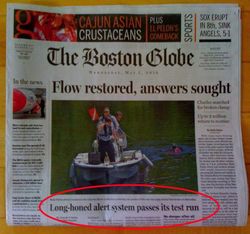
Aucoin's story Long-honed alert system passes its test run ran on the front page of today's Boston Globe. The story also ran online and was fed to the wire services for syndication. The story included a quote from me with a mention of my book The New Rules of Marketing & PR.
This example proves that reporters are scanning blogs for potential sources for their stories.
Get in synch with the real-time news cycle
Are you feeding reporters what they need?
While everyone knows that the online world is faster than ever, few people use the marketing and PR strategies (and tactics) consistent with this new reality.
I see PR departments, lawyers, and executives insisting on "reviewing" communications (which takes days or even weeks). When this happens, the crucial moment is lost.
When the old slow and steady approach is used, at best an opportunity is missed. At worst (in a crisis), the organization is seen as an unresponsive (and therefore uncaring) dinosaur, and customers leave in droves. (Just ask Toyota.)
I've got a new book coming out in November about this an other related topics called Real-Time Marketing & PR.
Stopwatch image: Shutterstock / Ilin Sergey


This is such a great post. I live in Nashville and it was inspiring to see how many Facebook posts and Tweets and Youtube videos were used as "news" for the flooding that happened. We are constantly inundated with events and now, like never before, we have a chance to be a part of the conversation in real time. I'm greatly looking forward to your new book, the previous have all been quite inspiring.
Posted by: Joey Strawn | May 05, 2010 at 09:38 AM
Thanks Joey - I've been watching the terrible flooding going on in your area.
It doesn't have to be a crisis to communicate in this way. Anytime something is happening and it is likely that a reporter will be writing about it is a good time to get something out there for them to see.
Posted by: David Meerman Scott | May 05, 2010 at 09:42 AM
David..You continue to SHATTER THE MOLD of the old way of PR activity. You are so right when you say that releases have to be looked at by the lawyers..then the moment of oppty disappears, since lawyers charge by the minute, they are going to do anything quickly. Horray for DMS!
Posted by: john Dipietro | May 05, 2010 at 10:44 AM
Great Post David. Was alerted to it via @edwardboches and normally I would dismiss a read like this out of hand with the headline. But then I read it and it is such a pristine example of the fundamental shift that has taken place. The tough part, as you note, is getting clients to understand and embrace the changes. The only part that isnt noted is the process--you have to have the blog our flash messaging platform to get it rolling. And thats where a lot of organizations fail--they might get it/want to do it in theory but arent willing to build even the most basic of infrastructure to support it.
Thanks again for the great read. I plan to share this with my team and some clients.
Posted by: Joe Hodas | May 05, 2010 at 11:00 AM
John and Joe -- thanks so much.
We are going through a communications revolution and those who understand the shifts enjoy success.
Posted by: David Meerman Scott | May 05, 2010 at 11:15 AM
David, great story within a business tip! Just spoke with a close friend yesterday who lives in that same area of Boston who was mentioning the water situation.
Question for you: This example shows that a reporter found you, a recognized blogger and best selling author (just friendly joshing at your celebrity status), had already mentioned the water crisis and reached out to you to add to his own story on the situation. But how would you suggest a business could benefit by blogging about their business news that could get a reporter interested? Say they have news that would typically be put out in the form of a press release (in the old days.)
I'm a big fan of yours, so I'm not trying to be challenging, just playing devils advocate. I completely agree with the theory that reporters are now largely out looking for stories and details by trolling citizen reporters, just ribbing you on the example. :)
Posted by: Christine Fife | May 05, 2010 at 12:11 PM
Christine - thanks for jumping in.
It did not matter that I write books in this case. The reporter was looking for a quote from someone about the communications and he found me. That could just as easily have been your Boston area friend who was found if he/she had blogged.
Regarding your question. There is a HUGE difference between helping a reporter when he is looking (like I did) vs. what you ask.
Your question implies that people should care about your news. But they don't. And they don't care about your products or services either. They care about themselves. And a reporter cares about the story that he is working on now.
So your job is to be aware of what's happening and try to blog about things of interest to your market, not about not about your own products and services.
BTW - I am not suggestion that putting out your news via release is bad. By all means do that when you have something to announce. (I use news releases when I have something to say). I'm just pointing out this example is different from what you ask in your question.
David
Posted by: David Meerman Scott | May 05, 2010 at 12:41 PM
Great Blog I will definetly follow. Just started blogging yesterday..... eeek wish me luck!
onegratituderock.blogspot.com
Posted by: Kate | May 05, 2010 at 12:53 PM
David
Great post. As a recovering decade long technology journalist I can say that one of the very first places I always went for story ideas and experts to quote in stories was Google and still is Google. It is also happening on platforms like Linkedin.com and Facebook.com more often, so I know your book will be incredibly valuable to all of us!
Posted by: nettie hartsock | May 05, 2010 at 02:30 PM
Useful post...thnx
Using new methods for new connections makes sense for PR, for analytics, for commerce and everything....
Posted by: Arnold Waldstein | May 05, 2010 at 03:42 PM
Do you think your blog would have been found if it didn't command Google authority (high PR)?
I think this post is powerful because it shows that you never know what can happen unless you try. It's very inspiring to people that don't think they could get press because THEY CAN!
See you Friday.
Posted by: Dan Schawbel | May 05, 2010 at 06:16 PM
Hi David, nice to see you at Simmons last week. Good pitch. (Must change some of the photography we use!)
Your post brings to mind the amazing success of a peer of mine, Linda Di, in China. She gets 60 - 90 thousand hits on a single blog post. I kid you not. (She showed me her analytics page.) I asked her, "HOW?!"
She said she often feeds current events into her posts, causing the national China on-line news service to pick them up, and run it on their front page (like a Google or Yahoo home page.) One of her popular posts discussed a Union/Labor situation and got over 900 comments!
She has terrific stories about what this exposure has done for the company brand she represents, as well as her own personal brand. Example: a business person in Korea ran into her boss in an elevator and said, "You work for EMC, hum? I don't know of the company. Oh, wait a minute. EMC. You're the company with the famous HR blogger!"
Cheers! Polly
Posted by: polly pearson | May 05, 2010 at 07:37 PM
David - Really Great Post!
I actually just stared at my computer screen for 2 min until the thought hit me - Is this a good thing or not?
Overall I know it is the wave of the future and a good thing; however, where is the line between good PR and reasonably objective journalism versus stories being picked up just because they show up in a blog? Are the facts really being verified?
In your case, it shows the power and the benefits of moving quickly in providing current information to journalists. My hope is all journalists will continue to pick up the phone(as in your case)to develop their stories before they run them in the more Traditional Online or Print publications.
One can only Hope - Great food for thought - Thanks again...
Posted by: Go2Mach2 | May 05, 2010 at 10:46 PM
Polly - The challenge for a technique like Linda uses is to make the posts relevant for the company. You can comment on American Idol and get some hits. But that's not such a big deal unless you sell, say, microphones.
Go2Mach2 - It doesn't matter if it is "good" or not. It is reality. Reporters no longer wait for press releases and PR pitches in their in-box. Instead they search Google when they are writing a story. It is still up to reporters at outlets like the Boston Globe to vet their sources.
David
Posted by: David Meerman Scott | May 06, 2010 at 05:15 AM
Great post.
It's very handy that the media need unique content and the easiest way to get that is comment!
A best-selling book or another celebrated accomplishment is handy, but you can demonstrate ability to comment convincingly on issues you know something about using podcasts and online video.
One day, the usual media contacts will be tied up in a meeting and you'll be in with a chance.
Where there isn't a major news story to hook into, we tend to go down the big issues route on the news agenda. It makes the client look good to be given a prestigious media platform talking about key issues affecting their industry sector.
I have had issues-led PR proposals knocked back by potential clients saying these ideas are "too aggressive" for them. But where are they now....
Posted by: Penny Haywood Calder | May 06, 2010 at 05:58 AM
Great post David. This is exactly what we, as PR professionals, need to be doing. Communications and the art of media relations has changed and given us all new opportunities.
Posted by: Shannon Cortina | May 07, 2010 at 07:54 AM
I like your post and I do agree with you. The only part that isnt noted is the process, you have to have the blog our flash messaging platform to get it rolling.
Posted by: prepaid mastercard | May 11, 2010 at 05:02 AM
David,
Isn't this still a commercialized game of chase, rather than a semantic web where it's easy to find what you need/want? News or otherwise?
Have you spent any time evaluating how corporations can support information availability in a real-time web when they're still encumbered by RegFD and the disorientation of search indexing based on SEO, Popularity, Paid links, or Virality - and not authenticated, semantic variables?
It's all well and good for someone to comment on news or the issue-of-the-moment, but it's hardly efficient for those searching or those responding. And when a Company is sharing actual facts, details, images, etc in a large scale, global environment, such information isn't naturally indexed for people to find.
I'm simply wondering when we'll move from a Search, Scrape, Copy, Link, Tweet, and Save web to one that enables embed-able, dynamic data that finds its way to us.
Posted by: Pro Journalist | May 20, 2010 at 12:49 PM
I think this is a great post because it is also very realistic and it perfectly describes the reporter's or at least the media's current tendency to do whatever it takes to obtain the best content to base their news on. With all the events going on nowdays, we can see those tendencies and they are not always good. Of course social media sites and their features have given them new sources of content for their news.
Posted by: Fred Kapoor | June 16, 2010 at 07:43 AM