



One student literally cried on my shoulder. Sobs and snot. (Really). I had never met her before. She came up to me after a speaking gig to tell me her story.
Another student asked: "Why do my professors not know about social media?"
Another emailed: "Two years going through an MBA program and Facebook, Twitter, and YouTube were never mentioned!"
Another: "Did I waste my money on a 1950s education here?"
Another: "Only one professor in 4 years understands today’s world."
Many university professors are criminals

Wikipedia says malpractice is: "a type of negligence in which the professional under a duty to act, fails to follow generally accepted professional standards, and that breach of duty is the proximate cause of injury to a plaintiff who suffers harm."
By not teaching modern methods to marketing, communications, and journalism students, professors are guilty of malpractice.
By not showing MBA students how to reach buyers on the Web, professors are guilty of malpractice.
I hope these professors have liability insurance, because my guess is that lawsuits are coming.
Here's what Jake LaCaze writes in a post called Mistakes I Made in College
"There was a time when I read nothing but fiction, fiction, fiction. Now, I read mostly business and marketing-related books. But in college, I didn’t go that extra mile to further my education on my own. I listened to the lectures and read the required texts all for the sake of passing the test. However, after reading books by authors like Seth Godin and David Meerman Scott, I’ve since discovered that most of what I learned in my business courses was obsolete. These two guys have taught me so much more than my lectures and classroom texts ever did. Please, go that extra mile. Pick up a book related to your subject. Professors teach the same subjects year after year. They teach the same material because it's familiar and rehearsed. But this is your future we're talking about. No matter what your major is, read books related to your major. You’ll be glad you did."
Here is the good news.
Hundreds of university professors are on top of modern marketing and are teaching students what they need to know to be successful in today’s world.
While I still get those gut wrenching messages from students, I also get many tweets, Facebook messages, and emails from others who are thrilled that their professors are showing them the world of Web marketing.
They reach out to me because over a hundred universities are now using my book The New Rules of Marketing & PR as a text in class.
Now, I'm not suggesting my book is the only way to teach this stuff. But because many students read my book, I'm hearing a lot about what's going down on campus.
Robert French, Stephen Quigley and Karen Miller Russell were three of the first professors embracing New Rules when it first came out in 2007.
"I've relied on The New Rules of Marketing & PR as a core text for my New Media and Public Relations course at Boston University for the last six semesters. David's book is a bold, crystal clear and practical guide toward a new (and better) future for the profession."
- Stephen Quigley, Boston University
"David Meerman Scott not only offers good descriptions of digital tools available to public relations professionals, but also explains strategy, especially the importance of thinking about PR from public’s perspectives, and provides lots of helpful examples. My students loved this book."
- Karen Miller Russell, Associate Professor, Grady College of Journalism and Mass Communication, University of Georgia.
Here's a post from Robert, a professor at Auburn University, from 2007 called Felling a Buzz.
Or read what Pete Codella, who created a course for the University of California, Irvine Extension says.
Time to pick books for next term
The higher education department at my publisher Wiley has made it easy for professors to check out the new second edition of The New Rules of Marketing & PR.
Since it's time to choose books for summer and fall courses, Wiley is offering free examination copies to professors.
Here’s what Wiley says about the second edition:
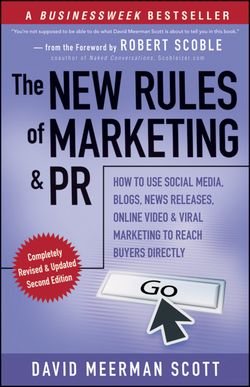
The first edition of this title presented readers with a unique playbook to navigate marketing in the Internet Age. Now, in this fully revised and updated edition, author and renowned online marketing strategist David Meerman Scott gives your students all the hottest insider tips so that they can confidently market any product, service, or idea. The book features new case studies and includes the latest marketing and PR techniques using social media sites. The New Rules of Marketing & PR shows readers how to leverage the potential that Web-based communication offers the business world.
If you are a professor, please check out my book. While I’d love it if you did use the book, you will certainly need to start teaching the new rules to your students. Either that, or check your liability insurance to make sure you’re covered.
If you are a student, please pass this blog post on to your professors or department head.
Image Shutterstock / Evlakhov Valeriy


Hi DMS,
Nice post. This articulates very effectively what is turning a lot of people off about higher education - the world is changing rapidly and it's really what you learn after college in the real world that matters... not going through the motions in order to provide 'correct' answers to questions on a test - a test written by someone who doesn't and most likely never has worked a real job in the field of marketing and advertising.
Thanks!
Mike July
Posted by: Mike July | April 02, 2010 at 10:27 AM
Amen, David. As with all things in life, there are those who care and those who don't. The important lesson is for students to learn to discern the real from the fake (professors, people & products).
I have made it a practice to recruit young marketers who have NO marketing education or background. To use jazz as a metaphor, I've found I can teach them scales, chords, harmonies, etc. I can't teach them feeling, improvisational surprise and texture. So I'm constantly on the lookout for passionate people I'd like to work with (and when the timing is right I try to hire them).
I would propose that Seth's Purple Cow, your New Rules and Tom Peter's The Pursuit of Wow be required reading for all emerging leaders.
Posted by: Keith Jennings | April 02, 2010 at 10:49 AM
Thanks Mike.
Keith, Interesting approach to your hiring. I said something related to that in this post.
http://coolmarketingstuff.com/best-marketing-career-advice/
David
Posted by: David Meerman Scott | April 02, 2010 at 10:54 AM
Reading this post, which I agree with, I kept thinking what kind of trial the Queen of Hearts and the Mad Hatter would run?
More seriously, in all fields there is a cogniscenti who, when presented with a "new way", especially if by someone or someones outside their group, don't want to be told. I'm thinking, at the moment, of the scientific establishment's resistance to Tectonic Plates, Evolution, Helocentricity... and these are the "objective analysis" guys. What happens is time and evidence get to a breaking point and, in a flash, the new way is accepted by everyone.
Your time, David Meerman Scott, is at hand!
:) Its spring, time to be fanciful
Posted by: Doug Brockway | April 02, 2010 at 11:02 AM
This is very similar to my experience from college. I went to college for Fine Art, (note the capital letters wink wink ) concentrating on photography and sculpture. The conceptual and philosophical education was excellent – HOWEVER – there was not a single course offered on “commercial application” of art. Commercial art and fine art are different paths, but the professors gave us no warning aka – $upporting ourselves commercially while we save the world with our aesthetics. A little “did you know that…” would have been a wee helpful. No regrets. It's easy to get locked in your era. Hell, I still dance 80's style.
Posted by: Bradley H. Smith | April 02, 2010 at 11:10 AM
Great post, David, and I'm glad you thought enough of my post to quote it in yours. This is a message that needs to get out, especially to business students. As Mike July says, the world is changing so fast. By the time we figure out new technologies, they've become obsolete. Unfortunately, business students are unaware of what they're not being taught until it is too late. They need to be told that a college degree is not their key to a career. It may actually be a hinderance because they rely on it too much.
And I think your book would be perfect for college courses. It's loaded with good information and easy to follow (the best formula for good non-fiction, in my opinion).
Jake LaCaze
Posted by: Jake LaCaze | April 02, 2010 at 11:13 AM
Jake - I wouldn't have done this post if I hadn't seen yours. You prompted me to think about this more than I had.
Bradley - Thanks for pointing out another example of this sort of teaching.
Thanks Doug - I played the Mad Hatter in my 5th grade play. Does that count?
Posted by: David Meerman Scott | April 02, 2010 at 11:58 AM
Can't agree more David! Although I will nor cry over your shoulder, I sometime feel upset. I remember my first talk with professor asking him about "story telling" in marketing,I still remembered the snicker, like I am totally an "outsider" who do not get what is marketing. I am not saying he is wrong, but I really appreciate Keith's approach to hiring. I believe everything in business, not just marketing, is about respecting people and understanding people. If MBA just gives a diploma, it's useless, especially in long term.
Posted by: Anqinglaowang | April 02, 2010 at 02:27 PM
Again, thank you David and all other ppl for your great comments. And really appreciate my classmate @JasonSerino and @genabron recommending your website and book to us.
Steven Wang
MBA Candidate 2010
Boston University
@Anqinglaowang
Posted by: Anqinglaowang | April 02, 2010 at 02:28 PM
We even used The New Rules in a marketing class in my Arts Administration program at Boston University. Arts Administrators get lost in the shuffle quite often, as we're not mainstream businesspeople and we're not always 100% artists.
For the people who sat in my classes, slack-jawed and asking, "What is this... Facebook ... thing?" the New Rules was a great primer. We really do need more of this kind of education in arts admin/management programs (and organizations!!), because many of the organizations we will work for in the future are sadly behind in so many ways.
Posted by: Libberding | April 02, 2010 at 02:34 PM
As an Cornell MBA graduate of '98, professors then were clueless about the technology developments inspiring the nascent dot com era, so it doesn't surprise me to hear they are not mentioning social media much in class.
In the defense of professors, social media is evolving quickly and school's job is not to prepare students for what is going to be hot in the coming months after graduation, but prepare students with problem solving skills and broad understanding of how business works which are the foundations on which MBA's must constantly adapt.
Given what I know today, I would be more impressed in an interview by a recent graduate who has a strong grasp of business fundamentals than one who knows how to utilize Facebook for getting a new product feature announced.
Posted by: CraigC | April 02, 2010 at 08:27 PM
Craig,
I hear you. But in today's world a professor has to be an idiot not to understand that every college student's communication's tools of choice are Facebook and IM.
And with that knowledge, to not teach that as a communications tool in class is simply malpractice.
David
Posted by: David Meerman Scott | April 03, 2010 at 06:27 AM
David, the discussion here is outstanding. May I please make the additional suggestion about the relevance of teaching social media to college undergrads and MBAs to not only prepare them for their future professions but also to help them gain access to rewarding jobs? I just received my print copy of Fortune Magazine and the cover story talks about how LinkedIn is a game-changing part of career strategy. In this brutal market, knowledge of traditional job searching techniques isn't enough to arm a new graduate seeking employment.
How many universities are educating their students about the value of LinkedIn or other social networks in gaining employment? Probably none. If universities want to continue promoting their prestige and educational value, they have to instill not only the teachings of the Godins and Meerman Scotts but also the teachings of the Dan Schawbels and Jason Albas.
Unfortunately, it looks like our educational institutions are guilty of educational malpractice on two fronts.
Posted by: Tony Faustino | April 03, 2010 at 10:47 AM
Concur, David. I am a management professor and I am the one in my College of Business teaching and speaking on social media. The marketing profs are not tuned in. This is such a unique subject matter - it is the only thing I teach that I really get to bring students along in an apprentice model. Because I practice this stuff myself (blog, Twitter), I am out there with them as I teach it to them.
Sure would like to get a copy of your new book to review :) I am selecting texts for my MBA class in personal branding.
Keep up the great work! Bret
Posted by: Bret Simmons | April 03, 2010 at 11:04 AM
Tony - I hadn't thought about the career office, but that is another place where criminals reside.
Bret - Thanks so much for commenting. Keep up the great work you are doing. I speak with students all the time, and it is instructors like you that change lives.
David
Posted by: David Meerman Scott | April 03, 2010 at 11:23 AM
"The New Rules of Marketing & PR" is an absolute must-read for anyone who aspires to be an effective marketer. It's one of the books featured in my free eBook, "Great Marketing Books Vol. 1." (http://www.viewfromthe14thfloor.com) I provide summaries of David's book and six others, along with links to Amazon.com to make them easy to purchase. If you don't own "New Rules" yet, I urge you to get it NOW!
Posted by: John Pohl | April 03, 2010 at 04:23 PM
I can relate to this post 110%. My college only educated us on traditional marketing and advertising techniques and it was not until the last two weeks of my college career that my professor pulled our your book and had us read a few chapters, hardly reviewing the content. Since graduation I have been immersing myself in web 2.0 and social media tools and wish my school knew about this stuff! I have since then gone back to my college to lecture on this material for the sake of my past classmates and my desire for them to know about this. (I guess you could say I am compensating for my professors' malpractice). I do hope more schools will start teaching on very up-to-date marketing trends. I understand it takes awhile to change a curriculum because of regulations, but since the market place is so dynamic today, colleges really need to take the extra time to develop more comprehensive and cutting edge technologies that can attract more students.
Posted by: Kristin Dziadul | April 04, 2010 at 10:09 PM
Thanks John.
Kristin - thank you for sharing your story. While it is unfortunate that you didn't get modern marketing in class, I applaud you for taking the time to share your knowledge with current students.
Hopefully your efforts will also influence the instructors!
Posted by: David Meerman Scott | April 05, 2010 at 05:15 AM
Dear David,
I tried to sue my college for malpractice but it turns out that all they actually agreed to do was to "share their passion" and "open the door to seeking the path that could help me help me advance to the next level in my professional development." Also the judge was an alum so I got socked with court costs.
Just kidding . . but . . . in truth, there's no malpractice or liability where no actual promises or real guarantees were made. can anyone show me a college website that guarantees you will acquire a specific marketable skill, or your money back? I like to believe they exist, but i have never seen one. --jl
Posted by: Account Deleted | April 05, 2010 at 10:22 AM
Amen
Talk to the "certified" marketing managers/directors working in the industry today and ask them IF their marketing works, then ask them HOW they know it does. 90% of them will respond with a story about how one time their marketing worked with one guy or they will be using inference with sales charts. "See that increase in sales there? That was when we changed our corporate colors to beige"
Like you've pointed out, it's because schools don't teach marketing from a pragmatic, experimental approach. You're getting an outdated set of best marketing practices from the 80's. A framework of how to adapt would probably be more useful than a lesson in what worked 20 years ago for most companies.
These days, the only thing those outdated best practices are good for is burning through a marketing budget with minimal results.
Posted by: Adriel Michaud | April 05, 2010 at 10:52 AM
To teach business without comprehending social media would be like teaching manufacturing without mentioning China. Might there be some good information? Sure, but...what planet do you live on?
And this reminds me of the sadly-prominent economics professor I met who declared in 2007 that derivatives and the housing bubble were "no big deal" and that "the market would fix it." Imagine charging $1000 per credit hour and hearing regurgitated bromides from the Chicago School. You'd be better off staying home and Googling Milton Friedman.
The real issue is charging $1000 a credit hour for ANYONE'S opinion...but that's another blog post, I imagine.
Posted by: Ericgarland | April 05, 2010 at 11:02 AM
Great post - thanks David. To achieve excellence in marketing we need to anticipate, adapt to and integrate change - technology is just one of these aspects. If we have the privilege of sharing our knowledge and experience in a formal learning environment - for me, it follows that we imbue our students with the same approach. As a marketing practitioner who enjoys sessional teaching, my classes are peppered with your videos and your books are recommended reading. (Am working on the 'prescribed'!) :) The real world application injects such life and practicality to the classes - bridging theory and practice. The students love the real world application.
As an MBA also - our learning never ceases. Meerman Scott, Godin and Peters are amongst my favourite authors and my own current 'virtual professors'. Our qualifications are just the starting point.
Posted by: Anne Sorensen | April 06, 2010 at 08:08 AM
I've read your book and I reference it all the time. I graduate with my MBA this June. In class, I had to be the one to bring up social media because it wasn't in the text. But once I did open the topic for discussion, my professors were more than willing to discuss it.I do think it needs to be incorporated in curriculm. Either that or professors need to read your blog and keep up with social media. It's were marketing is headed...all web. Even though I'm done with school, your books and others on social media will be what I use to further along my knowledge of marketing. Good Work DMS!
Posted by: Andreea Townsend | April 06, 2010 at 09:15 AM
This is really nothing new. I haven't met a single MBA grad, with a focus on marketing that has serious training in communication. 15 years ago I sat down with the provost of a major private university and asked about what MBAs have to do in communications and she proudly showed me a brochure for a one-week seminar on PR that all students were required to take. One week in a two year program on communications practices.
In 20 years as a communications consultant, I have not met a single marketing exec in any technology field with any clue as to how a print publication actually works.
The schools give what industry asks for.
Posted by: Lou Covey | April 06, 2010 at 08:53 PM
Lou - you're right. I have yet to meet an MBA grad who has gotten any decent insight into modern marketing while at school.
Posted by: David Meerman Scott | April 07, 2010 at 05:16 AM
Hi David -
While I agree with you that it would be really great for professors to talk about social media concepts in class, I've learned to cut them (a LITTLE slack). I too went through not only and MBA (in marketing and entrepreneurship, at a pretty good school to boot) but also a professional Master's degree, and there was little mention of new marketing etc. Was it frustrating? Yes. I got over it and founded a social media marketing firm out of school, and also am heavily involved in research in digital activism (MA degree was in International Relations).
But the real reason I cut profs slack is perhaps because I'm have academic at heart. The problem (which can really be blamed on the system.... something much more fundamental and difficult to change)... is that the academic environment (even an MBA) is restrained by the need to have frameworks in place. It's why fields like entrepreneurship have only blossomed in the past 10 years or so. While many profs were perhaps practicing these concepts, they were still not fully developed enough by the entire community of marketers in a way that it could be packaged into a framework that was "safe" enough to teach to to students paying $50K/year by professors who's jobs depended, in part, on the effectiveness of their coursework.
I think the biggest thing we have to think about is the "field" part... when is something an actual field?
However, I completely agree that SOME mention of these concepts would be helpful... especially now that we're several years into it for the most part. And you're also right, there are several great schools that ARE incorporating it into their coursework... and I couldn't encourage it more. I just understand a little bit why there are restraints...
What I've taken from it is that, as a professional, as an alum, as a mentor, I'll try my hardest to fill in that gap in a way that's meaningful to students in the applicable disciplines.
*gasp* sorry for the long one, wasn't expecting such a response!
Posted by: Kate Brodock | April 07, 2010 at 09:36 PM
Kate - I really appreciate your prospective here. Thanks.
While I am willing to cut the professors a teeny tiny little bit of slack, I simply cannot get around the fact that all (or nearly all) students use Facebook and IM to communicate with classmates. I have no doubt that study groups form and trade assignments via Facebook. If a professor does not know that she is utterly clueless and should be fired.
And armed with that knowledge if she does not learn about what's going down and adapt that to class she is guilty of malpractice.
David
Posted by: David Meerman Scott | April 08, 2010 at 04:30 AM
There is another danger I have recently come to see: The Miss-Use of social media by students.
Students are used to using e-mail and IMs and even Twitter for personal communications that they have no idea how to interact using this media in a business context. So when they do, because it is easy and the will eventually, they risk showing themselves as unprofessional. I saw this recently in my peer group.
Posted by: Kate | April 09, 2010 at 10:16 AM
A sad thing. It reminds me of my days in the late 1970s in Ann Arbor when the U of M speech/tv/film professors were all old guys who last worked in TV in the 1950s. Their whole focus was on teaching everyone how to direct a 3-camera studio newscast...meanwhile all the action and the jobs were about taking a single camera out in the field and documenting stuff.
Good discussion within the comments. Great subject.
Posted by: David Gordon Schmidt | April 10, 2010 at 11:12 AM
David, and when you consider the fully-loaded financial burden to complete a four year degree at any highly regarded university, perhaps that's the real tragedy -- the cost of being exposed to institutionalized mediocrity is expensive in 2010.
Posted by: David H. Deans | April 10, 2010 at 07:55 PM
Hi David,
I am a marketing professor and author of two introductory text books and a blog for marketing professors. I have a few comments on your very relevant post.
First, I want to thank you for your great book. The New Rules along with Groundswell, The Next Evolution of Marketing, Always On, Here Comes Everybody, all of Seth Godin’s books, and many others have been very influential in helping me understand where marketing practice is now and where it might be heading next. I am currently revising one of my text books and was listening to New Rules this morning (again) to get more ideas for the revision. In fact listening to the book made me realize that your blog was not on my RSS feeds and I needed to add it – and found this post.
Second, while not trying to make excuses for my profession, it is hard for many marketing professors to keep up on all of the changes going on in social media. When I last revised my book – just over two years ago, Twitter was a blip, Facebook was just opening up to non .edu addresses, and FourSquare was a twinkle in someone’s eye. Our books reference blogs, Facebook, and viral videos – but not as much as they should. We need professors to keep up on social media and find ways to integrate examples into their classes. Inspired by your book and others, we developed a blog that provides links to current content on marketing of all types – “Teach the 4 Ps” (www.teachthe4ps.com). I do tend to emphasize articles that provide examples of social media because that is where my text book – and all of those in the market – lags. Many marketing professors read my blog and bring this content into their introductory marketing classes. You and your readers are right, we owe this level of currency to our students. Besides, it motivates them to learn more about marketing when professors bring current examples into the classroom.
Another problem is keeping text books up to date. We are going to address this with a blog that targets students – and provide them with current examples and emerging concepts that keep their reading current between editions of the text book. We plan to launch “Learn the 4 Ps” next fall. Our book will also have a presence on Facebook (where students are in abundance) and Twitter (where few of my students reside – but they may be moving there). Our efforts on both platforms (at least with the current plan) will focus on provide relevant currency to supplement our books.
All of this said, we all need to be careful not to get consumed by the hype. We do not want to lose sight of the fact that by the time most of our students are out there working there will be new media and approaches they will need to integrate into their marketing strategy planning. We need to make sure our students have the core “rules” that will allow them to be effective in future environments. Many of our students, like yourself, were effective evolving to the new medium because you recognized which rules continued to be important even after the internet changed things. We believe there are some marketing concepts that will carry into the future (for example, market orientation, segmentation, targeting, positioning, strategy planning process, understanding consumer needs, etc.). These rules should be retained when we add your “New Rules.” A solid grounding in all these concepts – supplemented by examples and an understanding of the new and evolving media landscape – will best prepare our students for the rapidly changing marketing world they will enter.
Finally, I really love your book. Our students need to understand these concepts to be effective marketers in today’s (and tomorrow’s) environment. I hope that my colleagues will use the book in their classes – or at the very least read the book to make sure they are bringing an understanding of new rules and new media to our students.
Thanks again for your many efforts and insights which have kept me, my students, and the readers of our blog abreast of the latest changes in marketing theory and practice.
Joe Cannon
P.S. We are not all criminals -- and I think very few of us want to be.
Posted by: Joe Cannon | April 15, 2010 at 02:33 PM
Hi Joe,
I really appreciate you popping in and providing such a comprehensive comment. Sounds like you're doing an excellent job keeping current. I love the idea of a blog to do so,
I hear you on the book revisions. The second edition of New Rules came out in January and it does not include FourSquare. UGH.
Keep up the great work and thanks for all you do.
David
Posted by: David Meerman Scott | April 15, 2010 at 03:23 PM
I felt this way about my degree at Monash Caulfield in Australia, until I chose Peter Wagstaff’s (Wags) E-Marketing Unit. I, like many of your readers, became interested in Seth Godin’s books (In particular Purple Cow). So I felt starved for a more contemporary view of the 4 p’s. In preparation for this unit I read your book, which provided me with more than enough knowledge to engage in meaningful discussion on current ‘new media’ campaigns. This turned out to be the most useful semester I have ever had.
All submissions and out of class interaction were conducted via a wiki, set up especially for the unit. We as a group developed the wiki into our own textbook, with visuals and video included. A great way to study for exams! So there are lecturers out there that share your views. With teachers like Wag’s and Influencer's like yourself it won’t be long until the 4 P’s evolve into 5 or 6 and the tertiary marketing syllabus educates to arm students with all the necessary tools to speak to consumers.
Tony Wilcox
Posted by: Antonio Wilcox | April 28, 2010 at 07:52 PM
Tony, thanks for jumping in!
I'm so happy to hear about Wags and what he is doing. Sounds like you were lucky to have him as an instructor. Glad I could help in a small way.
David
Posted by: David Meerman Scott | April 29, 2010 at 05:17 AM
David,
I am quite impressed with your blog! Keep up the good work!
Rachel Florio-Urso
CEO, Producer & On Air Personality
RachelFloroPR.com
Posted by: Rachel_Florio | February 18, 2011 at 10:15 AM