



Many people ask me for advice about getting a business book published, so I wanted to blog it for all to see. See below for my 8 ideas if you are interested in doing a business book.
But first, check out this short video interview shot by my friend Tim Street where I talk about publishing a business book. Direct link here.
1. Know your goals for writing a business book.
It is unlikely you'll make much money from the book itself, so think carefully about why you are doing it. For most business book authors a book helps bring in consulting gigs, speaking opportunities, or serves as thought leadership to build a business.
2. You have many options to publish, including:
- Free ebook without registration (a book you publish online and offer absolutely free- no registration required)
- Paid ebook (sell your ebook on your site or via Kindle or other ebook software)
- Self-published print book (you act as general contractor and pay all the costs to design the cover, typeset, print, store, and ship the book)
- Author-supported publisher (work with a publishing house who serves as general contractor, but you pay all the costs)
- Smaller or niche publishers
- Large business-book publishers with international distribution.

Each of these approaches has merits and drawbacks. I’ve done a bunch of free ebooks, have self-published a hardcover book – a novel called Eyeball Wars (2002), worked with a small publisher, CyberAge Books on Cashing In With Content (2005), and the last several books I’ve done New Rules of Marketing & PR (2007 / revised 2010) and World Wide Rave (2009) have been with Wiley, the largest business book publisher in the United States.
4. Because it is so easy to put a book out yourself, you really do need to consider if you need a publisher at all.
Anyone can set up an account on Amazon and sell a self-published book. By doing a book yourself, you control more aspects and make more money per copy sold.
5. The main benefit of a larger publisher is distribution.
There are tens of thousands of business books published each year and only a tiny fraction of them ever make it into physical bookstores. Even fewer get worldwide distribution. So without a large publisher behind you with the contacts in the bookstore marketplace, it is unlikely that your book will be stocked at Barnes & Noble, Borders, and the other chains.
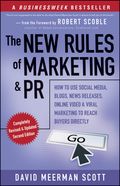
My book The New Rules of Marketing & PR is now out in 24 languages, plus on Kindle, in audio book format, and in condensed format. Each of these “subsidiary rights” brings the author more money and also increases the number of people who see your ideas. Again, working with a large publisher makes it much more likely that your subsidiary rights will sell.
PLATFORM PLATFORM PLATFORM
6. OK, so how do you get a big publisher interested in your book idea?
The most important thing is that publishers want to know how you will sell books for them. They are interested in your platform. A large publisher wants to know how often you’re quoted in the press, how often you speak, if you do television appearances. They want to know if you blog, tweet, publish videos. Basically, they want to work with authors who are likely to promote their books and make sales.
When I got my first book deal from Wiley, one of the most important factors was that I had published an ebook called The New Rules of PR (2006) that had been downloaded about 50,000 times in a month or so. The ebook had been written about on dozens of blogs. So showing that I had the ability to generate interest in my ideas, I was able to give the acquisition editor confidence that I could sell books.
7. Hire an editor.
No matter how you publish your book, it is important to have someone to work with to provide editorial advice. No writer can edit himself, and only a fool tries. A good editor pushes you to clarify your thoughts, helps with organization, and advises on the big picture.
8. Only you can market your book.
No matter how you publish your book, you must market it yourself. I recommend that authors spend as much time marketing a book as they do writing it. However, very few authors actually do it. Most either expect their publisher to market it or hope that the market will discover the book. Don’t assume. Get out and market your book.
Image: Shutterstock / Jacek Chabraszewski


David, thanks for sharing this. And thanks to Tim Street for the video.
Regarding ebooks, you really pressed some buttons in me when you visited us in Atlanta last Fall. I am producing my first ebook as a result. I'd rather try and fail, than fail to try.
Thank you for being the catalyst for that.
Posted by: Keith Jennings | January 14, 2010 at 10:06 PM
Keith - Please send me your ebook when it is done!!
Posted by: David Meerman Scott | January 15, 2010 at 05:07 AM
Great advice, David. For anyone interested in working with a major publishing house, Nos. 6 and 8 are key. It's all about platform - publishers are wholesalers and expect you to do the retail selling of your book. If you can't demonstrate that you have a platform, and you aren't a celebrity, they won't be interested in you. We work with a number of second-time authors who have felt burned the first time around by big and small publishers because of the expectation that the publisher would actually do some marketing for them. Selling your book is entirely up to you, as bizarre as that sounds.
And one more thing: the current economics of the publishing industry are unsustainable. Change is on the way, but no one knows what exactly it will look like. Try to retain as much control of your book as you can, so that you can have some influence over its future.
Posted by: Nick Morgan | January 15, 2010 at 06:36 AM
Well said Nick. Thanks for jumping in. As the book industry changes, it will be more important than ever to know your goals for publishing. Only then will the right publishing option for you emerge.
Posted by: David Meerman Scott | January 15, 2010 at 09:09 AM
Hi,
I read your 8 tips to get a business book published with interest and couldn't help noticing some typos and inconsistencies:
Tip 1 - change "form" to "from"
Tip 2 - you need a comma between "publish" and "including"
-4th bullet down, lowercase the "w" in "Work" to be consistent and omit the period at the end
-6th bullet down, to be consistent, omit the period at the end
Tip 5 - 2nd graph - italicize the name of your book and in the last line of that graph change "make" to "makes"
Tip 7 - insert a period at the end of "Hire an editor."
-insert the word "to" before the word "work" and insert a comma after "himself"
Tip 8 - put a comma after "Only you can market your book."
In my experience, seemingly harmless typos and errors can erode confidence in your message.
All the best.
Posted by: Tami | January 15, 2010 at 10:53 AM
Tami,
Thanks for helping me illustrate my point number 7: "No writer can edit himself."
David
Posted by: David Meerman Scott | January 15, 2010 at 11:04 AM
David,
Great post! As a designer and small author publisher, I have seen so MANY clients come to me with "books" they want to have printed that they have either designed or typeset themselves in Word or some other desktop publication. Often these books are nearly impossible to read from the perspective of eye flow, margins, etc.
So my added advice would be to take the step to hire a professional even when going the direction of self publishing. Beyond that, as I recently published my own book, "Market Yourself: A Beginners Guide to Social Media" as both a paid eBook ($5) and a trade size paper back edition on my site: www.marketyourselfthebook.com. I totally agree with you about reaching other audiences with the subsidary rights. It makes a HUGE difference as opposed to only offering one format. Not to mention the fact that actively USING social media (which is what the book is about anyway) to advertise and connect with your audience when promoting the books is crucial.
Thanks for the post! Keep them coming!
Posted by: JP Jones | January 15, 2010 at 11:56 AM
Thanks for the advice, David. A couple of months ago I got my first business book published ("Marketing Low Cost", in Italy).
How did I get the publisher's attention? I simply sent a very specific book proposal through their website, and much to my surprise, a couple of weeks later I signed a contract.
So you never know!
Our market is much smaller but still very crowded.
By the way, thanks for your "New Rules..." , which I referenced to in my book.
Cristina Mariani
www.cristinamariani.it
Posted by: Cristina Mariani | January 15, 2010 at 12:58 PM
Thanks for the tips! I have been noodling on a book idea for a while now and these tips are very helpful!
Posted by: Christine Fife | January 15, 2010 at 01:47 PM
JP - Yes, of course. I completely forgot. If you self-publish, you need a great designer.
Cristina - Congratulations!
Christine - Good luck getting a book out there.
Posted by: David Meerman Scott | January 15, 2010 at 02:15 PM
David,
Very rarely do you find someone who has done the entire gamut of publishing. Your experience is almost akin to the ascent of a musical band. There is no one path, but as a general rule you have to grind to build your platform. PROMOTE, PROMOTE, PROMOTE. Thanks for sharing and breaking it down in 8 tips.
Best,
Stan
@9inchmarketing
#PurpleGoldfishProject
Posted by: 9INCHmarketing | January 16, 2010 at 08:17 AM
hi,
Thanks for sharing the 8 tips!
I always wanted to have my book published. I find your article handy and helpful!
Posted by: enda | January 16, 2010 at 10:54 AM
Congratulations on your big win at http://speaking.com/top5/ - one place my vote actually mattered!
Posted by: Tehillah Hessler | January 17, 2010 at 03:44 AM
Thanks for the tips. You have inspired me to also create an e-book. Any resources on where to find an editor shall be deeply appreciated. I would need one. Keep up the excellent work!!!
Posted by: Roselynn Lewis | January 18, 2010 at 08:15 AM
@Roselynn - Try MediaBistro freelance job marketplace to find an editor.
Posted by: David Meerman Scott | January 18, 2010 at 08:29 AM
Hi David,
Thank you for this article. I've written four books on business ownership. The first was "Successfully Sell Your Business: Expert Advice from a Business Broker" which is available from Amazon and my website at www.Andrew-Rogerson.com. Your article points out what I failed to understand - once I'd written the books it was up to me to market them. However, this is almost an impossible task as my core work of consulting with and helping clients was demanding enough. I see great value with each of your suggestions and if you bring them altogether the bottom line is to create a business plan that realistically breaks down what needs to be done, costs and timelines. Thanks for sharing.
Posted by: Andrew Rogerson | January 18, 2010 at 10:52 AM
David – absolutely fantastic post – you are spot-on! I self-published a leadership book about 6 years ago, it has sold extremely well (@26,000 copies to date). Last year I sold a book to Jossey-Bass which was just named one of the top 10 small business books of 2009 – and you are 100% correct – it is almost solely the job of the author to sell the book. I spend at least two hours a day on “social media” and promotion – in addition to all of my client work and travel. A big-name publisher like Jossey-Bass mainly offers “credibility and distribution.” Now that the book is selling very well I have been getting more and more support from them – but in the early stages it was me at a computer trying to tell the world about my book. It takes a ton of work and networking – but it is also very rewarding to see your book climb the charts and to get wonderful notes from people all over the world who have read and enjoyed it. So, note to future authors – be prepared to market and promote your book like crazy – as you must be the main driver of your book’s success!
Posted by: John Spence | January 18, 2010 at 03:33 PM
Andrew and John -- Wow - you both have done really well. Congrats. Thanks for re-emphasizing that the author has to do the work. So few authors understand that.
David
Posted by: David Meerman Scott | January 18, 2010 at 05:29 PM
David,
I was at a Borders the other day, looking through business books and I was thinking to myself, man these things are a dime a dozen. I enjoyed your post and think you brought up a few great points. I think it all starts with number 1, "why are you writing another business book?" When you can answer that, you are already way ahead of the game!
Posted by: Promotional Products | January 18, 2010 at 06:19 PM
Very useful - especially #8. All the great content in the world won't do anything for anyone unless prospective customers know about it.
As I hope to jump into this line of work this year, I am glad to have read this prior to beginning the effort.
Thanks again!
MAS
Posted by: Denver SEO | January 22, 2010 at 12:57 PM
Those 8 tips are very helpful for who were publishing books.. Thanks for expressing your thoughts..
Posted by: Buy Effexor | December 10, 2010 at 08:13 AM