



Yesterday, Google announced on the official Google blog that real-time Web search is being rolled out.
In the Google search results, you will begin to see live updates from sites like Twitter and FriendFeed as well as instant headlines from news and blog posts.
This is important stuff. Really important.
My first job upon graduating from college was as a clerk in a bond-trading department at a Wall Street investment bank. I experienced first-hand the frenetic world of million-dollar decisions made in a fractions of a second because of a news story. I was fascinated by bond traders who spent their days glued to the Dow Jones, Reuters, and Bloomberg terminals looking for that instant newsflash with the power to change prices in real-time. But I was positively mesmerized with the real-time information! It was incredible to see news scroll by on the terminals as it was happening.
Of course, this was many years before the Web, when instant information creation and dissemination became available to anyone with an Internet connection.
But for more than a decade, except for some news sites focused on breaking news, the Web wasn't a place to do real-time research.
That changed with the phenomenal rise of Twitter over the past few years. Twitter allows people to share in real-time. And it allows instant research into what people are saying.
Still, I’ve found it odd that I've needed to go to different places to search for the information that is useful for me. I've used Google Web search for searching the Web for content that is a few days old or older. I used Twitter search (and services like TweetDeck and Twitterfall) to find things that are happening right now. I also rely on Google News for updates of news stories.
- Want to find out what people are saying right now at a conference? Twitter search.
- Want to find out what people said about the conference last year? Google search.
I'm looking forward to trying Google real-time search. Hopefully, now I'll find the majority of what I am looking for in one place.
Here's what Google with real-time content looks like in action (click to enlarge):
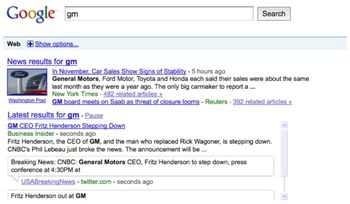
Image source: the official Google blog


As with all technology shifts, this move to real-time search solves existing problems, and creates new ones. This is great for entrepreneurs and marketers who realize that their job is to solve problems for customers. There is a window of opportunity for those of us that can offer practical tips and tools for leveraging this new access to information.
It was great reading your perspective. Thanks for sharing.
Posted by: Keith Jennings | December 08, 2009 at 10:29 AM
The one problem I have seen with real time data is how immediacy has inspired the trivial. I do realize Twitter search allows you to discover great nuggets of information but there certainly is a lot of nonsense out there.
One area of great interest to me and my company, Quired is Google's social experiment where if you sign up and log in - the search yields info from your community.
I believe the way forward is a combination of controlling the parameters of your results (date, location, etc.) and just as important be able match up your interests with others who tag information.
So if I am searching google for marketing ideas, I would get the latest post from David Meerman Scott, Chris Brogan, etc.
More of an interest engine than a search engine.
So I could have 50 people in my network whose opinions and interests I value, mine data for me. Then talk about advertisers they trust and now you have more of a recommendation than a pitch. (More value to the advertiser and the consumer I would say)
But yes real time data rocks and this is a great move for Google.
Thanks for sharing David.
Posted by: J. Paul Duplantis | December 08, 2009 at 11:26 AM
Thanks Keith!
Paul - wow - some good points here. Obviously I need to learn more about how Google real-time search will work.
Thanks for sharing.
Posted by: David Meerman Scott | December 08, 2009 at 11:33 AM
As the web continues to age, I can see Google beginning to struggle with this problem -- there is content on the web which is outdated and content that is timeless.
Consider an analysis of the Lincoln/Douglas debates of the 19th century verses an anlalysis of the iPhone 3G.
I agree with Keith, it appears that Google will soon have to muddle up that clean and simple interface and give us some parameters --- I just can't believe an algorithm will be able to automate good results as we move forward.
The age of the content is just one set of parameters -- there is types of content (video, audio, image, text) and intent of content (sales, informative, entertaining) to consider as well.
Posted by: Russ Henneberry | December 08, 2009 at 01:33 PM
It is interesting that it has taken this long to truly integrate these two forms of content - the real time and the "historical". Historically, they have represented different forms - real time being reporting of events and historical being analysis, insight and commentary - of content. The web has provided a way for that commentary to happen by more then traditional journalists, with value coming from a larger community. I see this concept playing an even larger role as the amount and timeliness of content increases.
Posted by: Cliff Pollan | December 09, 2009 at 08:00 AM
Agreed, this is tremendous. My dated real-time info experience was watching the wire service printers spew news overnight when I worked at a newspaper. This breaking news was effectively embargoed until the following evening when it went to production (then was printed and delivered, which added another six hours). First Twitter, then Google real-time search. Amazing how quickly we get news now.
Posted by: Kevin Cesarz | December 09, 2009 at 09:55 AM
I think regardless of its benefit the real time search is something that needed to be implemented regardless. I think this is only going to grow and over time will slowly get cleaned up.
Posted by: Nick Stamoulis | December 09, 2009 at 11:39 AM
Yeah, I noticed the transition to real time in my Google Alerts. But is this really a good thing? Now my mailbox is filling up with "alerts" triggered by the most trivial circumstances -- a random tweet, a stray Facebook comment. I think we'll soon rue this movement as a "careful what you wish for" kind of lesson...
Posted by: Jonathan Kranz | December 10, 2009 at 08:54 AM
Hi David,I would look forward to your future posts as you would be doing some research on real-time-web search.
Great comparison with the trading market as its almost the same situation now.
@Paul Some good points on what's next to real time web search I believe as Jeremiah Owyang has quite detailed views on the same to share he has termed that as intentional web, he has a great presentation on his blog.
I think we have already had a taste of it when twitter first promoted there search power.
But now as Google enters the stream we can have more details on everything and yes a lot less clutter.
Posted by: Akash Sharma | December 11, 2009 at 08:29 AM
Good points on real time web search to find out the information via google.Thanks!
Posted by: Personal Training London | December 26, 2009 at 01:56 AM
Search is a natural starting point for discovering the world's information.Now, immediately after conducting a search, you can see live updates from people on popular sites like Twitter and FriendFeed, as well as headlines from news and blog posts published just seconds before..
Posted by: investor business daily | February 10, 2010 at 04:32 AM