



I've been talking about blogging and ethics for a while. For example, I wrote a post called What would your mother say? Blogging and ethics back in 2006. (BTW - 2006 was about two decades ago in dog… er, I mean Internet years).
The issue keeps coming up. John Cass recently wrote about a blogger at WebEx who posted a review of a competitor's product. And last week, the U.S. Federal Trade Commission published regulations last week targeting bloggers, and a furious discussion ensued.
My friend Andrew Davis Chief Strategy Officer at at Tipping Point Labs has an elegant solution. He suggests a visual code (see draft 1.0 below). It reminds me of how Creative Commons works which I really like. I'd imagine that the icons would link to web based information just like CC does.
I love it. What do you think??
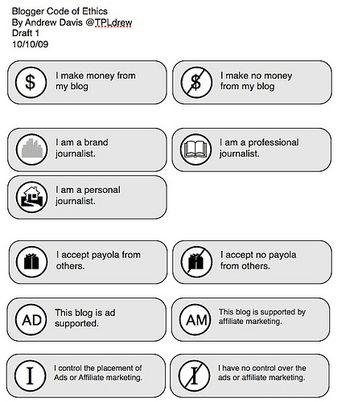
One suggestion Andrew As an author and someone who occasionally reviews books, I’d like to have a clause saying that works such as movies, music, and books that are frequently sent for review to bloggers be in another category than “payola.” The relationship between the media of all types and those of us who create works like books, CDs, and feature films has always included free review copies. (FYI - I get more than 100 unsolicited review copies of books per year.)


Re: "FYI - I get more than 100 unsolicited review copies of books per year."
David: I read a lot, I'd like to get as many review copies as you... Maybe I won't get quite as many, but a few would be nice. Suggestions?
On another note, I dig the graphic(s) noted above...
Posted by: Ricardo Bueno | October 11, 2009 at 06:48 AM
David,
I am a huge fan of full disclosure, but I suspect that the relationship between influence and bias is often (or even mostly) not based on cash. That becomes virtually impossible to sort out so cleanly.
- If a blogger works for one company and reviews a product built buy a partner during the early stages of a partnership between two companies
- If a blogger's main source of income is as a professional speaking, and he/she discusses a company's upcoming product release while talking with that company about a speaking engagement
- If a blogger has an industry-specific blog, and finds his/herself looking for regular employment, and provides reviews of the products of potential employers in order to garner a conversation
All of these situations are very biased, but not cash-related. I'm not sure that it would be easy to bucket the types of bias so cleanly. We may be best with a "sunshine" policy of simply declaring any potential sources of bias, to your own best knowledge.
Great conversation to start though, thanks for highlighting it.
Posted by: Steven Woods | October 11, 2009 at 08:27 AM
Steven -
You're absolutely right. Thanks for mentioning this. I deal with this situation all the time because when do seminars at companies or keynotes at conferences, I always learn something that's interesting and I frequently blog about it.
While I don't know how that non-cash influence can be put into a code of conduct, I am personally a big believer in disclosing those relationships.
Here is an example of how I do it (see my disclosure at the bottom). http://www.webinknow.com/2009/04/top-gobbledygook-phrases-used-in-2008-and-how-to-avoid-them.html
Posted by: David Meerman Scott | October 11, 2009 at 08:44 AM
Thanks everyone for the conversation. It's really not just about following the money. It's about defining the actual terms and having people pledge (or sign) the code of ethics which will define the kinds of things your talking about in broad terms.
To address Steven's points: A BRAND JOURNALIST - someone who writes content on behalf of a brand or a company should always be read within a specific context. That means as a reader you always know that anything they highlight could be a partner, competitor, friend, enemy.... etc.
Again, even someone like David Meerman Scott would be considered a Brand Journalist if he decides that he generates revenue as a direct result of the content he creates here. (does that make sense?)
If the person with the industry blog had agreed to the "professional journalist" code of ethics, they would be in violation of the code if they just started writing content about potential employers.
Ok, I've written enough here. I'm working on a website for it: http://bloggercode.org
Thanks so much for all the great discussion. I think this has real potential, as long as the code is defined.
BTW, David - thanks so much for checking it out. I've been thinking about this for a long time.
Posted by: Andrew Davis | October 11, 2009 at 08:57 AM
Thanks David, for your posts.
I´ve learned too much with you.
Priscila Borges
triborp.blogspot.com
Brazil
Posted by: Priscila Borges | October 11, 2009 at 09:33 AM
Very cool and I admire the simplicity in the visuals! This is an important issue requiring a solution, and I think you and Andrew Davis nailed it.
As food for thought, how would you disclose during your review of a specific product or service that you're a bona fide user or client of the organization? For example, I'm a Premium Member of MarketingProfs.com. In the next few days, I'm going to publish some blog posts about the key learnings I derived from attending their Fall 2009 Digital Marketing World Conference.
I was planning on disclosing my relationship as a MarketingProfs.com paying member in the introductory post. Essentially, it's my unpaid endorsement to promote the wonderful things Ann Handley and her organization does to enhance the learning of all marketing professionals.
Hope you don't mind me asking. Just want to be transparent.
Posted by: Tony Faustino | October 11, 2009 at 02:14 PM
Tony - Coincidently, I was with Ann this morning (yes, a Sunday morning). I'm sure she'd be thrilled.
I think I'd say something like "I've been a MarketingProfs Premium member for two years, and..." (or something like that). I am a fan of disclosing without actually disclosing if you know what I mean.
Note in the beginning of this post that I say "My friend Andrew Davis..." I did this because I know him. We've had lunch together. I've been to his office. That's not the reason I blogged however - I did so because his idea is great.
David
Posted by: David Meerman Scott | October 11, 2009 at 03:19 PM
I love the idea and have long expected some kind of code of ethics would eventually be formalised for bloggers. Of course, the issue then becomes that the least scrupulous - and most in need of declaration - would be the most likely to eschew these emblems and codes.those of us who believe in such declarations are- as David has illustrated - already very careful to state our 'allegiances' in any relevant post.
Posted by: Kimota | October 11, 2009 at 07:08 PM
David,
I think this is a very good post, and I think simplifying the whole process about identifying who a blogger is and where exactly their motives lie is a very good thing.
I think these images simplify the use of Creative Commons which many, many people have no understanding of.
Good post,
-Brad Wellman
http://wellmania.wordpress.com
Posted by: twitter.com/bradwellman | October 11, 2009 at 08:38 PM
Hi David,
I think the above graphics are a good first step in the right direction. That being said, I think that the readers need to take information they read on blogs with some skepticism and do their homework on researching about the author, their motives and background. Of course having disclosures and other material would help, nevertheless we still need a proceed with caution sign!
Regards,
Omar
Posted by: Omar Halabieh | October 11, 2009 at 10:11 PM
I think it's a good start. However, just at first look, I would need to have about 3 or 4 of those on my blog to cover the way I do things. Now if there was a way to combine some of the categories... For instance, I have 3rd party advertising which I don't really control, but I can opt out of certain campaigns. And I *DO* have control over affiliate marketing.
I guess you can't cover everyone, but I do like the similarity to CC. Maybe I'm wanting it a little more flexible, yet still more granular? Or maybe there should be fewer categories?
I don't know. I think it could use more discussion, but I love the concept.
Posted by: becky | October 12, 2009 at 02:00 AM
I have to say this is a great idea. I'm not sure if it would take off, but I do like it!
It will definitely make it easier to work out who a blogger is and what their goals are. This is a great idea!
Posted by: Amelia Vargo | October 12, 2009 at 03:54 AM
I like it. It is easy to use and to understand. May be it needs some more occasion to be disclosure, but the ideas is great.
Posted by: Dessislava Boshnakova | October 12, 2009 at 04:07 AM
Thanks for your post David. It's all about transparancy. Very important in a more journalistic approach of marketing & pr is that you not only make clear in every post/article if you're potentially biased but also say how. You're gobbledygook-post is a good example how to be transparent.
Posted by: Wim Coenraadts | October 12, 2009 at 04:53 AM
A couple of thoughts on how to enhance this very smart idea:
(1) I don't think you need the "AD" icon, as the ads on the blog should make it clear that it's ad-supported.
(2) I'd come up with a euphemism for "payola", as I don't see many bloggers wanting to associate themselves with that term. ("Compensation" perhaps?)
(3) I'd use another icon for "payola" (or "compensation"), as the current one is hard to decipher. (Perhaps a paycheck?)
Great initiative, Andrew. Hope my comments are helpful. And thanks for sharing, David.
Posted by: John Pohl | October 12, 2009 at 09:12 AM
I love the idea of these icons, and would gladly use them on my blogs, especially if the icons could link to a page describing their meaning.
If you'd like some help developing a PHP or JavaScript page that would generate an icon cluster and link back to a page describing them, let me know.
Posted by: Brent P. Newhall | October 12, 2009 at 10:06 AM
Those graphics work for me. Obviously, you'll want to spell out more details of your own code of ethics on a gobbledygook page (maybe that'll become the industry standard terminology for it) - but few people will read that.
The graphics give them what they need to know at a glance.
I'd also agree that we need a different graphic for getting freebies to review. Getting lots of free books in return for a review sounds like a great deal for a blogger if you've not done it before. But when you do it regularly, investing hours in reading & reviewing a book that probably cost the writer/publisher a few bucks to get to you doesn't feel like a "gift".
In fact, I'd like a little graphic that shows a huge pile of books gathering cobwebs and an apology note for being so backlogged with reviews...
Ian
Posted by: ianbrodie.myopenid.com | October 12, 2009 at 11:09 AM
Like the graphics, may get noticed more than fine print like "Advertorial."
I'd probably respect a blogger or journalist more if they put in big, bold letters: "I wrote this review after they sent me a free product sample/book/ticket" on the posts.
I follow one tech writer on Twitter b/c at the bottom of a story, his bio said something along the lines of "I am blah blah..and I tweet @thisname because it's my job and I have to." Nothing says honesty, integrity to me more than transparent disclosure. FWIW.
Posted by: Davina K. Brewer | October 12, 2009 at 02:56 PM
I like the idea of icons. Icons play an important role in developing the applications. I hope it really works as well.
Posted by: vitamin b12 | November 10, 2009 at 12:22 AM
