

It doesn't matter what industry you're in, we can all learn from the marketing that smart rock bands are doing online.
So how do you launch a rock super group?
Well, everyone knows the rules. You spend months in the studio cutting a killer album with a major record label. You set a release date and prior to release you get your friends in rock media (like Rolling Stone magazine) to review it. Your management company and label figure out what single to release and you get radio airplay and do a music video. After the record has been out for a few months, you do a multi-city tour based on the success of the album.
Everyone knows that's the way, right? Well, everyone is wrong.
When I was at Lollapalooza last month, the biggest buzz was not from any of the 150 or so bands that took to the six stages over three days. The most anticipated show was a "secret" late night club gig by Them Crooked Vultures, the band's first-ever public performance at Metro, and it was the talk of Chicago. Alas, with a teenage daughter in tow, we didn't make the age requirement for the club so we didn't even try to get in.
Them Crooked Vultures formed in Los Angeles this year. How about this lineup: drummer Dave Grohl (Foo Fighters, Nirvana), vocalist and guitarist Josh Homme (Queens of the Stone Age & other bands) and bassist and keyboardist John Paul Jones (Led Zeppelin). Sweet.
I'm absolutely fascinated by how Them Crooked Vultures is launching.
After the club gig during Lollapalooza weekend, the band travelled to Europe for a club show at Amsterdam's Melkweg, followed by several UK festival-related gigs.
The band's official web site is, to be polite about it, limited. It's got like four pages and one of them doesn't work. But a link from the site goes to an active forum where passionate people can discuss the band. I'm intrigued by a new band that runs an official site that is really nothing more than a place for fans to congregate.
There's a Twitter feed @crookedvultures and a MySpace page. The other official online content is the band’s YouTube channel, but here again, Them Crooked Vultures has taken a highly unconventional approach. The channel has a few videos produced by the band including some studio rehearsals. But the majority are amateur videos shot at the band's several live shows.
Remember, this is a band that does not yet have an album. You can't buy the music. Yet instead of crying "copyright infringement" and calling the lawyers to get YouTube to remove the vids, the band encourages fan videos of their original and unreleased songs and even put the best ones on the band official YouTube channel.
Damn. I love it. The traditional major label guys must be going into convulsions at what is completely foreign to their way of thinking.
As people enjoyed the videos, the band announced a small number of additional club dates in North America and Europe. When tickets went on sale Saturday (maximum number per order – two tickets), they sold out in, like, two seconds. (Yes, I scored a pair for the Boston gig).
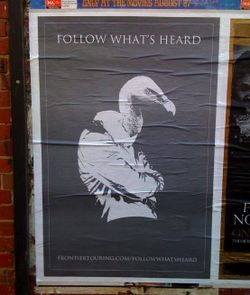
While I was in Australia last week, there were rumors flying around about some dates down under. Clues were a cryptic rock poster titled "Follow What’s Heard" with a URL that leads to a countdown clock. Savvy fans figured out what it likely meant and are filled with anticipation for the possibility of Aussie dates being announced.
Imagine what's next for Them Crooked Vultures
Here's how the launch is likely to play out. The band plays the dozen or so small club shows each in North America, Europe, and Australia. Tickets are scalped for big bucks. Lucky fans who get in are ecstatic. The forums are abuzz. The YouTube videos hot. A bunch of tweets and blog posts. Rock reporters from the newspapers in each city where there is a club date will write a glowing feature (the most excellent Sarah Rodman from the Boston Globe will write the one for my city). A World Wide Rave.
Then, quite a bit later, an album comes out that because of all the pre-buzz debuts in the top ten (or even number one) on Billboard. An arena tour follows. A band is born.
Sure beats what everyone knows is the way to launch a band.
What about your business? What can you learn from Them Crooked Vultures?
Australia poster photo via DogwoodRust


Yes I am sure there are many other businesses that can learn from this story.
It is a 'bottom-up' rather than a 'top-down' approach that many of us find refreshing and stimulating.
Thank you so much for sharing the story.
Posted by: strategyweb.wordpress.com | September 09, 2009 at 11:03 AM
I understand the point you're trying to make here David, but to me, this is just more of the same.
There are hundreds and hundreds of bands trying cute bottom-up tactics to gain a following. Hey, a few of them have even succeeded on a small scale. But do you really think this would have been successful if it wasn't Dave Grohl, Josh Homme, and John Paul Jones? I worked with the Foo Fighters for a few years, and although they always had big money behind their album launches, they always started their album promotion with similar tactics to what Dave is doing with Them Crooked Vultures.
In my opinion, this is just technology catching up with the same mass marketing masked as "viral" that's always gone on. As a former "major label guy" I'm still waiting for a real example of musical emergence without either financial intervention or built-in celebrity to leverage - after all, you don't really think those "home made" signs we used to see in Times Square outside TRL were actually made by the fans, do you?!
Color me a pessimist, but just like politics and the media, big budgets are still king.
Posted by: Simeon Margolis | September 09, 2009 at 11:30 AM
It is a great story, but Simon's comment sort of rung the reality bell.
However, the point I think David is making is that there are different ways to approach things than the standard practice. Sure, some of them require big budgets to pull off big things, but that doesn't mean an impact can't be made by trying something different.
For me, this scenario says more about "super experience" than it does, "super group." Perhaps that's what Grohl was trying to present? Regardless, that's something we can all think about on our own terms.
Posted by: Jon Mueller | September 09, 2009 at 12:18 PM
Great post David.
Compare that to the story of another "supergroup" called Chickenfoot, who spent millions on an album, publicly declared it to be better than Zeppelin and Van Halen, and then let the world down with an album that was just "decent". The advance hype killed the project. A approach like Them Crooked Vultures would have worked so well for them. http://brandlikearockstar.blogspot.com/2009/04/hagars-hype.html
Posted by: Steve Jones | September 09, 2009 at 01:08 PM
I've been following this one too David, but given my cynical take on whatever is left of the music "industry" I'm with Simeon (although I got the take away from Jon too). I'm wondering if this is more an example of using the tools and techniques we all love as a way to manipulate and game the results? Big fan of Grohl (& JPJ getting a paycheck), but I'm more partial to social media music tweeps like @jodyg @MatthewEbel, @matisyahu @ylove @nossonzand (my bro) and @NatalieGelman or even the wider influence of Radiohead, NIN or experts in community building Anni DeFranco and Pavement.
In answer to your question about what businesses can learn, seems like another industry under threat - US auto makers - is embracing social media.
By the way, putting on my official "High Fidelity" book badge, all rock super groups suck ;).
Posted by: Adam Zand | September 09, 2009 at 01:57 PM
Simeon, Adam, Jon - sure, you couldn't pull this tactic off without the star power of the musicians. But I still love the alternative approach and the use of social media in this case. And I do think that other organizations with "star power" (Microsoft for example) can learn from this.
I do like the example of Bec Holcraft using alternative tactics to launch. She was 17 when she started and unknown. She's still not a household name but has potential.
http://www.worldwiderave.com/2009/02/bec-hollcraft-and-her-world-wide-rave.html
Many thanks for the comments.
David
Posted by: David Meerman Scott | September 09, 2009 at 03:44 PM
This approach is becoming more and more common among bands. Without a doubt torrents are making bands music more widely accessible and easier to obtain.
If people can get music for free after hearing about them on their Myspace, Twitter feed word of mouth, or random blogs, they can 'test it out' on torrents for free.
The marketing of the band is sound and keeps evolving using new tools. The means of obtaining the product have changed and are only getting easier for the end user.
Posted by: Matt Dyson | September 09, 2009 at 09:28 PM
Sounds like they've taken a page or two from The Grateful Dead playbook. After all, they sustained decades of success, built not on "hits" (didn't have one, "Touch of Gray," until relatively late in career), but on fan engagement: encouraging fans to make recordings they could swap
Posted by: Jonathan Kranz | September 10, 2009 at 08:46 AM
Great article, David, especially since it tackles one of my favorite subjects: music and the challenge of promoting it. I think if John Paul Jones of Zeppelin were not a part of the band, there wouldn't be nearly as much attention paid. Dave Grohl is fairly well known, but Josh Homme is not a mainstream name (well, at least to me!). Still, whoever is behind the promotion is quite savvy about what they're doing.
Ultimately, the proof is in the pudding. You predict that they'll eventually come out with an album that will debut in BB's Top 10 - maybe even at #1. We'll see. As big of a Zep fan and Foo Fighters fan I am, I didn't hear enough in the admittedly limited videos to inspire me yet. 'Supergroups' are notorious for imploding from expectations (Asia or Blind Faith, anyone?)
I actually liked Chickenfoot on the first listen through...but will it wear? After spending 25 years in the radio biz - much of that as music director - I can tell you that predicting the success or failure of any act is a fool's bet. I would like to see your follow up after their first album has been out a couple of months!
Posted by: Tim 'Gonzo' Gordon | September 11, 2009 at 01:23 AM
I have to agree with some of the other comments here, without those big names in the band this probably wouldn't have been such a success. However, I love the approach made by them and if this is the way that new bands will start to get known then I think that it will be great for the music industry.
Posted by: Amelia Vargo | September 11, 2009 at 03:41 AM
Tim - You are right. I should get out of the prediction business...
All - great discussions. Thanks for your participation.
I still feel that the approach taken by TCV is interesting because it is alternative. Build fans first and then do an album is not a mainstream approach.
David
Posted by: David Meerman Scott | September 14, 2009 at 04:21 AM
Pop stars go even further:
Get pictures into the gossip magazines for any reason.
Best gossip about nothing winner:
Lady Gaga
She appears dressed special clothes or outfits and the gossip maginzes print them.
Whatever you think of her music, but she made a splash headstart.
Not exactly low profile entry into the business and she sold records.
Posted by: EngagoTeam | September 17, 2009 at 10:41 AM
I feel that the approach taken by TCV is interesting because it is alternative. Build fans first and then do an album is not a mainstream approach.
http://www.digbands.com
Posted by: dig bands | September 17, 2009 at 01:13 PM
This is great. This is essentially the same as The Grateful Dead formula you mentioned in World Wide Rave. A little love and sharing between fans goes a long way!
Funny how time hasn't changed a thing!
Posted by: Jeff Ramos | October 08, 2009 at 08:45 PM
There's a word missing here. Conversation. If one engages in a conversation with with a fan or a 'customer' and they do most of the talking - you've hit the jackpot :)
Good article though.
Posted by: ian | December 15, 2009 at 03:57 AM
thanks admin exciting blog
information is the most beautiful treasures
Posted by: sikiş | January 07, 2010 at 10:03 AM
I worked with the Foo Fighters for a few years, and although they always had big money behind their album launches, they always started their album promotion with similar tactics to what Dave is doing with Them Crooked Vultures.
Posted by: reverse phone detective | September 16, 2010 at 08:28 AM
I'm still waiting for a real example of musical emergence without either financial intervention or built-in celebrity to leverage - after all, you don't really think those "home made" signs we used to see in Times Square outside TRL were actually made by the fans, do you?!
Posted by: how to grow taller 4 idiots | October 09, 2010 at 06:12 AM
Sounds like they've taken a folio or two from The Grateful Dead playbook. After all, they abiding decades of success, congenital not on "hits" (didn't accept one, "Touch of Gray," until almost backward in career), but on fan engagement: auspicious admirers to accomplish recordings they could swap
Posted by: Spy on a phone | January 15, 2011 at 10:08 AM
We're starting to see shorter and shorter promotion windows in today's crowded music marketplace. Cultivating a core following for your band using Facebook et al is the way to go.
Posted by: Band Promotion | April 09, 2011 at 05:48 PM