



UPDATE
About three hours after I sent the post below, I was contacted by Deb Collins, VP of Sales & Marketing at Delaware North Companies Parks & Resorts. Please be sure to read her comment (the 5th one below my original post).
+++++++
ORIGINAL POST
I've been noticing more and more people playing fast and loose with email opt-ins. Maybe the tough economy forces otherwise reputable organizations to go close to the edge? Or maybe email marketing programs are relegated to junior marketers who don’t know better? Sure, one person may buy your product, but is it worth annoying thousands? Is the economy really that tough?

Readers of this blog know I am a fan of the Apollo moon program. Obsessed is a word my family would use. Need proof? Here’s my Apollo Artifacts blog.
I've been to Kennedy Space Center in Florida several times, most recently to watch the launch of STS-117 and to attend events with Apollo astronauts. So that I am alerted to upcoming Space Shuttle launches, I signed up for emails. Here’s what I signed up for:

"Get the latest on upcoming launches. Sign up for free e-mail updates and we'll send you the latest information on launches and Kennedy Space Center events throughout the year."
I got this in a return email:
"Thanks for signing up for information on launches and events at Kennedy Space Center Visitor Complex. We are excited to have you as a member of our distinguished online community and hope you find our website user friendly and informational. We will update you throughout out the year on special events, promotions, newsletters, and discounts. Thank You!"
So far so good.
A typical email signup that happens millions of times a day. I wanted information and KSC agreed to provide it.
But some time later, I received this email
"FROM Kennedy Space Center Visitor Complex
SUBJECT Last-minute summer escapes from Delaware North
At Delaware North Companies Parks & Resorts, we realize what summer is all about. It's our chance to get away from work and home as we search for a little adventure, reconnect with nature and forget about some of our responsibilities. That's why you'll find a number of affordable summer packages, unforgettable events, fun activities and more at all of our destinations this summer.
Beat the heat as you hike or bike your way through the High Sierra at Yosemite, Tenaya and Sequoia. Treat yourself to a spa treatment at Gideon Putnam. Or saddle up and ride to an old-fashioned barbeque at Yellowstone. Choose a category below to find out how we can help you satisfy your sense of adventure."
I feel abused. This is not what I signed up for.
Turns out Delaware North is a resort operator that runs the Kennedy Space Center Visitor Complex.
It seems clear that the fine print of what I signed up for with the Shuttle launch emails from Kennedy Space Center entitles Delaware North to pimp their other properties.
Yes, the Delaware North lawyers were satisfied. But that does not make it right to abuse fans of manned spaceflight by hawking a trip to Finger Lakes Gaming & Racetrack? No. Of course not.
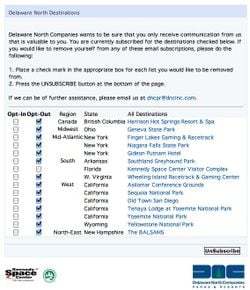
When I went to opt-out, I had to click on 14 different check boxes (each one returning me to the top of the page) which took more than a minute. [NOTE: Click the image to enlarge.]
What makes marketers at Delaware North think that because I want to know when NASA is launching a Space Shuttle that I might also be interested in Southland Greyhound Park in Arkansas? Obviously the only connection is Delaware North and for that reason this is an abusive practice.
Seth Godin outlined permission marketing best practices ten years ago in his book by that title. Yet these sleazy practices still go on.
Delaware North should re-think their email marketing strategies.
Or perhaps NASA should re-think Delaware North.
What about your email marketing practices? Are you playing fast and loose?


That's a pretty bad case. I don't think it's a function of the bad economy causing sleazier practices, they were always there. It's this sort of the thing that makes people think all marketers are bad. The problem is the view that all email addresses are of equal value, no matter how they were obtained. That's simply not true as we (you, the people who read your books and blog) well know.
Posted by: Charles Neville | August 11, 2009 at 09:08 AM
I see this all the time -- and seethe. Both as an annoyed consumer and as a marketer who hates seeing the profession abused like this.
Posted by: Jonathan Kranz | August 11, 2009 at 09:15 AM
Something similar just happened to me. I signed up for a local business happy hour some weeks ago, and now I'm getting email marketing messages from the bar where it was held. I didn't ask for this.
Posted by: Jodi Kaplan | August 11, 2009 at 09:37 AM
If the company keeps that many distinct email opt-in flags then you'd like to see those at the time of sign-up. That might scare some people away because the form is too long and requires more clicks. But at least the customer gets to decide upfront which email they are opting in to receive.
A worse case scenario is if the company only keeps a single opt-in flag for all emails. That becomes one size fits all and you may have to just unsubscribe if you get content you didn't want.
Posted by: Bob Williams | August 11, 2009 at 12:30 PM
Dear David:
I want to thank you for helping us catch an issue that is counter to our intent and practice. Upon reading the blog, and researching the situation, we immediately pulled all other scheduled sends of this format and are taking corrective steps to remedy the problem.
As a way of background, we are very proud to operate in some of the world's most special places and place high value on dealing with our guests with integrity and transparency. Our research has shown that a majority of our guests are looking for other unique life-enriching experiences. Toward that end, we issue a quarterly email that provides information and value-added offers for the location to those who have signed up. In these emails, we also introduce our other locations, unless the person has opted only for that location.
We recently redesigned the email format and the email you reference was the first send of that architecture. In reviewing the email, I can see how you came to your conclusions as it does not follow our typical content standards – where the content is focused on the original location, not generic about all locations.
Add insult to injury, we recognize that the opt-out process is cumbersome and are in the process of changing over our email service provider for a more user-friendly process for both the opt-in and opt-out actions.
While no marketing professional likes to read something like this about their own company (in fact "horrified" describes it at best!), I appreciate your insight that will help us look more closely at this practice and make quick adjustments to something that could have damaged our relationship with other guests. My only regret is that our normally rigorous QA and internal data-integrity process didn't catch this before this version was issued in the first place.
Deb Collins, VP of Sales & Marketing, Delaware North Companies Parks & Resorts
Posted by: Deb Collins | August 11, 2009 at 12:52 PM
Deb,
Many thanks for taking the time to quickly reach out to me and also to leave the thoughtful comment. I'm sure my readers appreciate it.
It is certainly encouraging that you have reviewed your email marketing programs and that you have made changes.
David
Posted by: David Meerman Scott | August 11, 2009 at 02:50 PM
Hi Deb
Probably the best damage control response to a blog / email / hidden camera TV show or other public rant, that I have ever seen. Well done.
Straight out of "The New Rules Of Marketing And PR", co-incidentally written by David Meerman Scott.
PS, Great book David, I have nearly finished it.
Posted by: Tom Butlin | August 11, 2009 at 05:47 PM
This blog post and the associated replies is a living proof of something we discussed earlier in the blog post on Amazon's gone wrong Kindle experience (http://www.webinknow.com/2009/07/amazon-apologizes-for-orwell-kindle-mishap-but-was-it-too-late.html). It does prove that when incidents such as this one are handled promptly and appropriately and addressed directly to the user community that raised them does make a big impact/difference! Great work Deb, and I hope other companies follow suit.
Regards,
Omar
Posted by: Omar Halabieh | August 11, 2009 at 09:32 PM
Wow! Deb is fast. David, can you ask her to share what tool she used to detect your original post? Cheers!
Posted by: Colin Warwick | August 11, 2009 at 09:53 PM
Nice work. I think a lot of this stems from people not being email marketing experts. Those of us who've been around for a while realise that we need to offer good content and not annoy our subscribers if we want to have long term success, but a lot don't realise this.
Maybe we need to let these people know what they're doing wrong, like David did here :)
Sean
Posted by: Sean | August 11, 2009 at 11:44 PM
I've had the same thing happen with Newsmax. I signed up for David Letterman's Top 10 every day. Instead, I received a bunch of other gibberish. I've tried to unsubscribe twice (the same 14 choices that David mentioned) and HAVE BEEN UNABLE TO! So now I have a rule to delete anything from Newsmax before it arrives. Which makes me mad and bums me out at the same time because now I can't receive the Top 10 list either.
Posted by: Brenda Sullivan | August 12, 2009 at 10:41 AM
What a great email marketing example, from both David and Deb. As a fellow marketing director, I oversee eight different businesses, and I make it excruciatingly clear to each business and my team that there is to be no intermingling of email lists across these businesses. Here's why:
*Customers trust us with their information and when we acquire it, we need to remember that they are customers and that we are grateful that they would spend their dollars and time with us. You cannot violate this trust - ever - whether on premise or virtually.
*We could be sending something that they do not care at all about, so when we do send them relevant information, they hit delete before they open it (as to Brenda Sullivan's post before mine.)
*Cost. Not many people know that email newsletters have costs - the people to research and write, as well as the email subscription. We pay $16 per 1,000 emails sent. That adds up. You know only 20-30 percent of people will even open them on a qualified opted-in list. If I send an email to 10,000 people, and only 2,500 open it, then I have already wasted $120. This adds up for small companies. And will that $160 (+ labor) bring in the business? Is your offer compelling enough to get people to act?
Posted by: Margaret Ebeling | August 12, 2009 at 11:54 AM
Check this irony out!
Some marketers have a tiny check box at the bottom of their comment box. By default, it is checked!
So if you visit their blog to leave a comment, you are automatically signed up to receive their free reports.
Even though technically, you did not opt-in.
Yes, these are the same folks that preach the "permission marketing gospel".
Posted by: Oritseyemi | August 12, 2009 at 01:23 PM
What a great discussion. Many thanks to all for commenting. I've learned a lot from this and am glad that I wrote the post and that Deb commented.
Posted by: David Meerman Scott | August 12, 2009 at 04:25 PM
In reading David's post and following through the commentary, this is a great case study. Situation-problem-solution-result. Good one for a conference presentation.
So much of the frustration I find comes from the opt-out process being muddied up (screwed up) by lawyers justifying themselves. That's where the real sleaze is. At that point it's not about marketing, it becomes a situation where the lawyers and accountants are running the asylum. Sort of like Planet of the Apes gone awry.
Deb did a good job of following up and addressing the situation. Very commendable.
Posted by: Joe Ray | August 12, 2009 at 05:41 PM
I see this happening entirely too often, but there is a bright side; Deb responded very quickly and I give you so much credit for that!
Posted by: Elizabeth K. Barone | August 12, 2009 at 10:23 PM
This post, the swift and sincere response by Ms. Collins, and the insightful discussion points are why I read WebInkNow daily.
What I find most impressive about Ms. Collins' response is the genuineness of the apology and the stated approach for correcting the action. Bravo! A real person stating how her organization will thoughtfully take corrective action. In my opinion, Ms. Collins turned a potential PR nightmare into a PR 101 learning opportunity for Corporate America.
Posted by: Tony Faustino | August 13, 2009 at 09:25 AM
Following up my original comment (#3 above):
I emailed the happy hour organizer and complained about the unwanted marketing. Yesterday, the restaurant called me, apologized for the error, and thanked me repeatedly for complaining!
Posted by: Jodi Kaplan | August 13, 2009 at 11:07 AM
I'm not so sanguine, here. Deb is spinning. Do they really believe, "Our research has shown that a majority of our guests are looking for other unique life-enriching experiences".
Wow, well if that's true, why do it only four times a year? Four times a year is the sort of strategy you'd take if you only wanted to annoy people a little, but not enough to make them flee.
If they had the guts to use OPT IN (which is real permission) then they'd have the privilege (not the right) to email weekly. But of course, that's not what they do, because they're not thinking like permission marketers.
Points to Deb for speed, but not for the organization that clearly doesn't get it. She shouldn't be fixing their opt out in the email, she should be fixing the opt in in the first place. The button you clicked on doesn't match, "In these emails, we also introduce our other locations, unless the person has opted only for that location." You clearly opted only for one location, right?
Posted by: Seth Godin | August 13, 2009 at 11:25 AM
Seth - Yes indeed. I am only interested in Kennedy Space Center, not the rest of the stuff. So anything else is an annoyance.
It will be interesting to see if they really do fix it or if they continue to try to sell me stuff I do not want.
Posted by: David Meerman Scott | August 13, 2009 at 07:35 PM
Thanks for sharing this story here and in your presentation. I'm a big fan of using a bad situation to build advocates and Deb's quick response was admirable.
Posted by: Tom Kelly | August 14, 2009 at 01:12 AM
Great discussion. I think the macro of this speaks to how fast communication is changing. What used to be considered the norm, interruption marketing, is now completely unacceptable. Permission is key and without it a business will lose.
Posted by: Robert Wogrin | August 14, 2009 at 03:00 AM
Great post! I can so relate to feeling "abused" by email subscriptions, but the best part of this post was the discussion that came out of this post and the great example Deb displayed on the importance of trying to turn a negative into a positive. Thanks David for posting this and allowing us the chance to see some great marketing communication.
Posted by: Angela Rivera | August 14, 2009 at 03:57 PM
Having worked for an enormous international company with a multitude of divisions, I am not surprised that this sort of thing happens all the time.
Without an indivdual or centralized team charged with overseeing cross-business customer experience and playing ringmaster to what is otherwise a circus, the potential for miscoordinated opt-in gathering and email campaign efforts is immense. Add to that the reality that most senior management teams in established old-school organizations have a reverence for the inexpensive cost of sending email and have little appreciation for the hornets nest into which they walk constantly.
If someone in the organization could present the risk/reward scenario to leaders at these organizations, they'd ensure that the way they set up their processes and systems prevents these scenarios from occurring so that any info sent to these customers and prospects continues to adhere to what the recipients signed up for in the first place.
Posted by: Teri Gidwitz | August 16, 2009 at 04:02 PM
Like Brenda on August 12, I have tried unsuccessfully to unsubscribe from Newsmax.com. We receive probably 4-5 emails per day from them. Does anyone know how to contact their webmaster to complain?
Posted by: J White | August 17, 2009 at 09:12 AM