



When I wrote The New Rules of Marketing & PR, I added the URLs of Web sites, blogs, podcasts, YouTube videos and other links at the bottom of the each page in case readers wanted to go to the sites I was discussing in the book. Many people commented that it was helpful, so I repeated in my new book World Wide Rave.
But now I wonder. Could I have done more?
Zak Nelson asks: "Why aren't books more like websites? Or even magazines, for that matter? Or hell, like comic books?" Zak sent me a diagram of what he's thinking (click the image for an enlarged version).
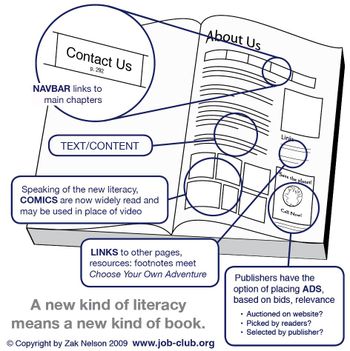
Zak wrote to me while he was reading New Rules… at a cafe in Queen Anne in Seattle.
"Sitting next to a guy pecking away at some code for a web 2.0 site he's working on," Zak wrote. "On my other side two women rue the economy. Across from me a fellow reads the Post-Intelligencer, which will soon go extinct. Classic scene."
Zak says there is a new literacy taking hold, and traditional book publishers aren't keeping up:
"I'm a comics geek," he says. "I love the explosion of new indie comics and high caliber graphic novels appearing on the scene, and selling well. People in general are becoming more literate in comics: with more exposure we are learning how to better read them, and authors/artists are stretching the boundaries of each page and panel. Moreover, comics are typically sold in an affordable, cheap-to-produce format, and are only bound and sold as graphic novels after a series has had its run, and then only if it sold well enough to warrant the cost of creating a book.
Similarly, people are becoming more literate in reading websites, and that neural reconfiguration may well be affecting how traditional books are read and sold (or, unsold as the case may be).
So what if a book read more like a website? What if it looked more like those Choose Your Own Adventure books, with links to other chapters, pages, and even other resources in the marginalia? What if there were paid advertising on the page, but not traditional ads but rather something more akin to Google AdWords, where the placement is determined online in a bidding process coupled with consumer-driven inputs? What if on the printed page, instead of single photos or illustrations with captions, books adapted the concept of the embedded YouTube video, and used a storyboard format--i.e., a comics format--to depict a scene, when sequential visuals are required?"
What do you think? Is Zak on to something here?
Zak Nelson is a marketing and PR professional with five years in the book publishing industry. He is now looking for a new opportunity. He started a Job Club site in early 2009 to bring job seekers in the Seattle area together to share resources, encouragement, and accountability in job searches.


I'm an old-school book reader, not a comic book reader. It's bad enough that we don't deep-dive focus when reading any longer - jet skiing instead. But now we need to have ads and visuals and sidebars to encourage the jet skiing?
I'm just not sure about this one. The sheer volume of data we're required to process is falling away from our critical thinking capabilities like tears.
Posted by: Kevin Grossman | February 02, 2009 at 11:25 AM
With new reading devices like Amazon's Kindle, armed with WiFi, this vision may not be very far away.
It's reasonable that parts of the book would be loaded from RSS feeds from a central repository to maintain maximum currency and relevance.
A VERY interesting view of what the world might be like.
Thanks!
- Daiv http://Twitter.com/DaivRawks
Posted by: DaivRawks | February 02, 2009 at 11:25 AM
Hi David and Zak:
I think a lot of developers and book publishers are on the right track and SOME books are becoming more like the web. Two years ago at the inaugural O'Reilly Tools of Change conference, attendees were treated to a glimpse of what kinds of projects might be possible when Manolis Kelaidis presented his blueBook project (more on that here: http://booktwo.org/notebook/the-bluebook/ and here: Manolis Kelaidis "bLink: Completing the Connection Between the Analog and Digital Worlds" http://conferences.oreillynet.com/cs/toc/view/e_sess/14393).
Lots of us will be back at the third annual TOC conference next week in New York to further examine the dizzying possibilities of mixing books up with the web (and beyond). http://www.toccon.com/toc2009
Lots of exciting things happening, and lots of excited people making them happen.
Posted by: Kat Meyer | February 02, 2009 at 11:37 AM
I'm torn. My first thought is to scream "apostasy!" and run to protect my bookshelves teeming with traditional literature.
The problem arises when I get to my bookshelves and realize that there's a fine layer of dust on nearly everything there. Sure, I have a few books I go to regularly, but it is true, much of my reading has moved online, either to my PC or my Palm smartphone. (I regret to admit that I am not cool enough for an iPhone yet.)
That being said, on those times when I do settle down with a bound mass of pressed wood pulp, I find that I do so in order to escape from the confines of 2009. I want to immerse myself in the content of the book and get lost. And if there's one thing I've discovered from reading online,it would be that it's very challenging to get lost when you have a navigation bar and site map available on every page.
Maybe some books would indeed be improved by this approach. Maybe our goal as Americans should be to ensure that every last one of the 310 million of us aught to be as ADD as a social media addict trapped somewhere between YouTube and Twitter. Or maybe we should drop the navigation bar and back away slowly from that bookshelf.
Posted by: somecallmejim | February 02, 2009 at 12:29 PM
One more significant. yet until now, not very widely known fact concerning the future of books and publishing limited to the old "dead tree media." There now exist books in digital format which are simply too voluminous to publish on paper. Google Books is now working to put online what will be the world's largest ebook, published by Millisecond Publishing Company, Inc. and written by Bruce H. Harrison. His book covers a segment of the deep family histories that have been uncovered and connected over the last 13 years by the Family Forest Project. Look for an announcement soon from Google Books and the Family Forest concerning the first time online release of the world's largest ebook. http://www.familyforest.com
Posted by: Tom Nocera | February 02, 2009 at 12:30 PM
I've been thinking a lot about how more mainstream people will figure out and embrace all the new technology and tools. I think people will continue to gravitate to books and the books will need to evolve and be even friendlier. So I think you're on exactly the right track.
The 'dummies' series seems to be humming right along with their sidebars and icons.
The google chrome comic did a very good job explaining what's different about their browser.
The folks at xplane have been using pictures to explain complex ideas for 10 years now.
David, the path I sense you're going down is to make your argument as well as you possibly can in your books, but accept that there is more information that can help your reader. Great! Make it as easy as possible for your reader to completely immerse herself in your idea.
Posted by: Mark | February 02, 2009 at 12:46 PM
It depends. Who's the audience for the book? Are they really familiar with the background concepts? Does the meaning depend also on the style of the narrative? Is the book intended to be timeless or timely?
Pretty much any book could be enhanced by having "special features" available online and with end of chapter or book appendices pointing to them. But Zak is suggesting a far more integrated approach. I think it would be great for certain topics, such as health or current history, but not as useful when deep thinking or a longer attention span is called for, whether in business or in fiction.
Creating books that look like what Zak is imagining would probably replace only a portion of the current books being published but it could expand the entire market for bound stacks of paper by adding customers who are not currently attracted to that format. Eventually it might have an interesting value proposition war with electronic readers but how soon that would arrive would likely depend on price barriers.
Posted by: Beth Robinson | February 02, 2009 at 12:59 PM
Wow. Terrific comments here. Thanks all, for your thoughtful contributions to the discussion. Lots of interesting stuff here and food for thought for what both authors and publishers should be thinking about.
Posted by: David Meerman Scott | February 02, 2009 at 01:41 PM
Interesting idea, but I cringed at the "ad goes here" box.
These days people seem to assume that every available surface on Earth is just waiting for an advert to be stuck on it. That kinda depresses me.
Posted by: Quaker120 | February 02, 2009 at 02:43 PM
It depresses me that the book envisioned here are ideal for an audience that is unable to concentrate on prose and unwilling to follow a series of thoughts that goes on longer than a paragraph or two.
The new literacy sounds a lot like the old illiteracy to me.
Posted by: John | February 02, 2009 at 04:27 PM
I'm a huge fan of any media type evolving, and books are no exception. I do think, however, that there is a place for the format - in the sense of "200 pages to deeply explore a concept" - that we don't want to lose.
Whether it is digital, paper, or other doesn't matter, but there is value to the deeper explorations. I don't know that many online styles are suited to that length of exploration at the moment (200 page blog post, anyone?).
The next 5 years will be very interesting.
Posted by: Steven Woods | February 02, 2009 at 04:30 PM
Tom have all books fit into the website-design model is a bit like saying all music should be rock.
There is room for classical - even to those who are not fans. (Ever seen a movie?)
Posted by: Paul Merrill | February 02, 2009 at 04:38 PM
David - great discussion. Books are morphing, and yet staying the same. Many ebooks have live links. These can take you to video, audio, etc. Traditional publishers, like newspapers, need to make some changes or they, too, will become a footnote in some media professor's ebook.
But the big thing (we have discussed this a couple times now) is to presetned the information the way the audience wants it - and here there is no uniformity.
I may not like my books the way Zak likes his, and vice versa. If you have a book, in all likelihood you can make an ebook. If you don't want to record it yourself, hire a professional voice, then you have an audio book.
There are lots of things you can do with words.
Posted by: Mark Amtower | February 02, 2009 at 05:07 PM
Zak is clearly thinking along the right lines, but the focus on making a book more like a Web site is misleading.
Books (print or digital) serve the purpose of examining an issue in a limited range of a certain number of pages. There always will be a purpose for that. Don't get bogged down in a future of the book debate.
The emphasis should be not on books at all but on how to transition content-rich Web sites in a way that supports a new way of "reading" that incorporates text/images/video/audio. That also requires a new way of writing. I've always thought that documentary films rather than books provided a better approach for understanding where this discussion should head.
Publishers must figure out how to monetize content without getting stuck within the book (or even e-book) paradigm.
And, yep, monetizing a web site is still the hard part. We know how to monetize books, which is why the conversation too often drifts back to the future of books. But the real discussion is in the future of Web sites.
Posted by: Jeff | February 02, 2009 at 07:39 PM
I feel the content dictates the presentation. And you can not forget about the audience.
I'm not a purist when it comes to the written word - but I just finished reading Hunter Thompson's The Rum Diaries. The thought of that book reading like a blog or website is quite terrifying. It probably wouldn't work.
Posted by: DaveMurr | February 02, 2009 at 08:47 PM
I think there is a place for this type of book model and believe that to reach a more in touch generation that has grown up on multi-media this may be a great method. I also think that some material is much more interesting if presented in this format, like the book Adventures of Johnny Bunko presented career guidance.
But I am not so sure that I am keen on having ads placed in a book that I am going to purchase.
I am an avid reader of traditional books and find them my personal preference for pleasure reading; however, I also read blogs and website regularly and would welcome this as a potential format.
Posted by: Jeffrey | February 03, 2009 at 12:10 AM
Fascinating and exciting, but not new. Galileo tightly integrated graphics with his text and Newton was able to accomplish something similar. Both made the written page much more information-rich and still managed to communicate complex ideas.
Edward Tufte's website has much more on this, for example the page http://www.edwardtufte.com/bboard/q-and-a-fetch-msg?msg_id=0000hB&topic_id=1 has lots of related ideas.
His (Tufte's) books are works of art (and craft) in themselves and well worth a look!
Posted by: Robert Meekings | February 03, 2009 at 06:55 AM
I love the idea for non-fiction...just don't touch my beloved novels!!!
Posted by: Julie Roads | February 03, 2009 at 08:08 AM
Personally, I find attempts to mimic web page design in books annoying in the extreme. Online, I can get the immediate gratification of clicking on a link or back and forth among several pages. Offline, these text elements are distracting. I don't think we want to give up our ability to sustain a train of thought. We're already seeing the affect of our diminished capacity in this area in the political sphere, where the call to arms on passing a near trillion dollar spending bill is, "We don't have time to think about it. We have to act now." Are we conditioning ourselves not to think?
Posted by: Brad Shorr | February 03, 2009 at 10:04 AM
The book industry is the moral equivalent of a technology company stuck in a mainframe computing paradigm. Batch, slow, rigid and new stuff comes out incrementally on yearly release cycles. The whole world has moved to become more real-time and online. Why not the content we're publishing in books? It could be so much richer an experience and stay fresh longer as new content is introduced. Zak is definately on to something.
Posted by: Phil Myers | February 03, 2009 at 02:11 PM
Thanks for putting thought into this!
I would add that the web became what it is partly because this is what books have always *wanted* to be. I've been designing publications for that long, and jumped onto the web because of this very promise.
Now that we have ideas like Kindle, the Book will have another way to evolve. I don't think there's any point in trying to control it. The old monks have all died, and anyone can be a scribe.
Our children will write books we never dreamed of. Let's just make sure they also have leaves to touch, fresh air to breathe and long afternoons by a creek or a beach. This is the stuff of a rich, deeply-diving, freely thinking world.
Posted by: Penina | February 03, 2009 at 04:37 PM
As a reader of books, I don't like the idea of having videos instead of pics/photos on a printed page particularly non fiction categories. I think some things should be left to the reader's imagination.
As a writer of fiction, I am loving this idea.
Posted by: Rosemary Ambale | February 03, 2009 at 11:02 PM
Books and screens, whether TV, computer or phone, 'impress' our thinking and our imagination. Their format, too!
Hence the educational / informational responsibility seems to lie in the combination of the designer and the content provider.
Hopefully we lengthen attention spans for deep diving, and widen association gaps for free thinking, methinks...
Posted by: Sabine K McNeill | February 04, 2009 at 01:44 AM
I think there is room for this for certain types of books (like how-to decorate your house, or a manual). You could write out the instructions in words, and then show someone doing it.
However for extended reading (such as a novel or a biography), I think it's a mistake. It discourages paying attention for extended periods of time and makes it harder to absorb what you're reading.
Posted by: Jodi Kaplan | February 04, 2009 at 08:24 AM
This is an interesting thought exercise, but imprinting the Web paradigm this deeply on printed books is a non-starter.
Web interfaces evolved the way they did because of the capabilities of the medium, not necessarily because it's the way most people want to read. Take away those capabilities--hyperlinks, video, audio, etc.--but leave the elements and you get a pretty distracting, fragmented, and hard to read mess.
That said, if you have a print-on-demand model and allow the user to choose the style they prefer, e.g., "low graphics and no external references/links/ads" to "show me everything," then perhaps you have a plan. Interestingly, a reader could choose to have contextual ads included in their book in exchange for a lower price.
Now, take that same paradigm to the Kindle and it works better. Links, video, slideshows, etc. become more functional, but the Web-style content and UI should still should be adapted for the limitations and usage of the device.
Interesting conversation and ideas here. Really enjoyed it.
Posted by: Rob | February 04, 2009 at 09:49 AM